Pet-Safe Houseplants: The Complete Checked List
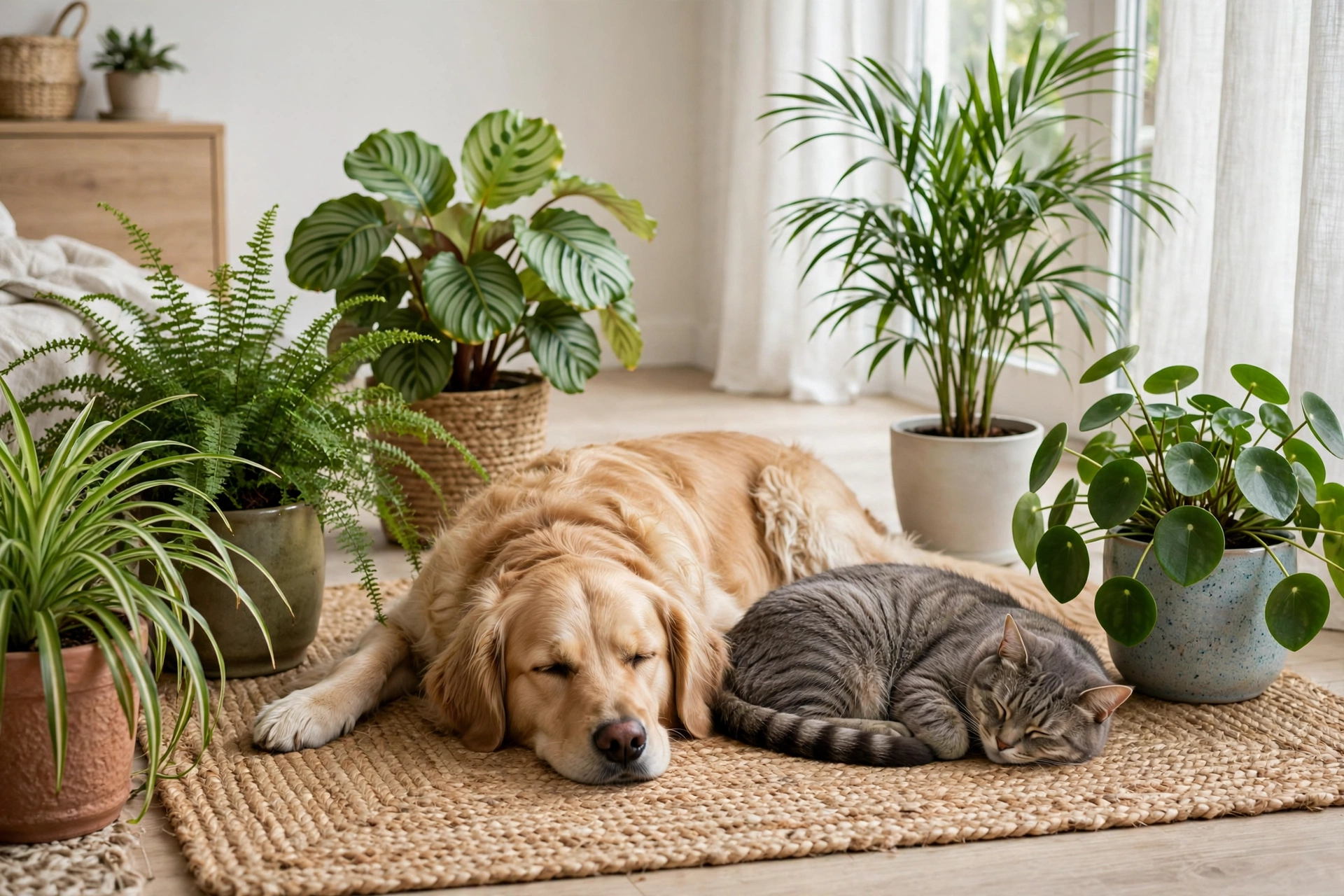
If you share your home with a cat or a dog, you have probably been given the standard advice: just don’t keep houseplants. And if you have tried to research your way past it, you have met the other problem — “pet-friendly” lists that copy each other, disagree with each other, and never say what they checked. One site’s safe plant is another site’s toxic one, and your pet is supposed to bet its stomach on the difference.
This page is the list of pet safe houseplants built the way a vet would build it. Every plant below has been checked, by botanical name, against the ASPCA’s Toxic and Non-Toxic Plants database — the same reference veterinarians use — and included only if it is listed as non-toxic to both cats and dogs. Where a famous look-alike is dangerous, that is flagged too, because the mix-ups are where pets actually get hurt.
Quick Answer
Pet safe houseplants are plants listed as non-toxic to cats and dogs in the ASPCA’s plant database — no poison in the leaves, stems, or roots if a pet chews them. The 25 picks below are all double-checked for both animals, grouped by the job they do in a room. Two cautions come free with the list: “non-toxic” does not mean “edible” (any plant can upset a stomach in quantity), and a safe verdict applies to the exact botanical name — look-alikes with similar common names can be toxic.
Table of Contents
How this list was checked
One source, applied strictly: the ASPCA Animal Poison Control plant database, searched by botanical (Latin) name for every entry, because common names are where errors breed. A plant made this list only if the ASPCA lists it as non-toxic to cats AND non-toxic to dogs — several popular plants are safe for one and not the other, and a pet home usually cannot run two standards. You can verify any plant yourself the same way in the ASPCA’s toxic and non-toxic plants database — it is free, and it is the check your vet will make too.
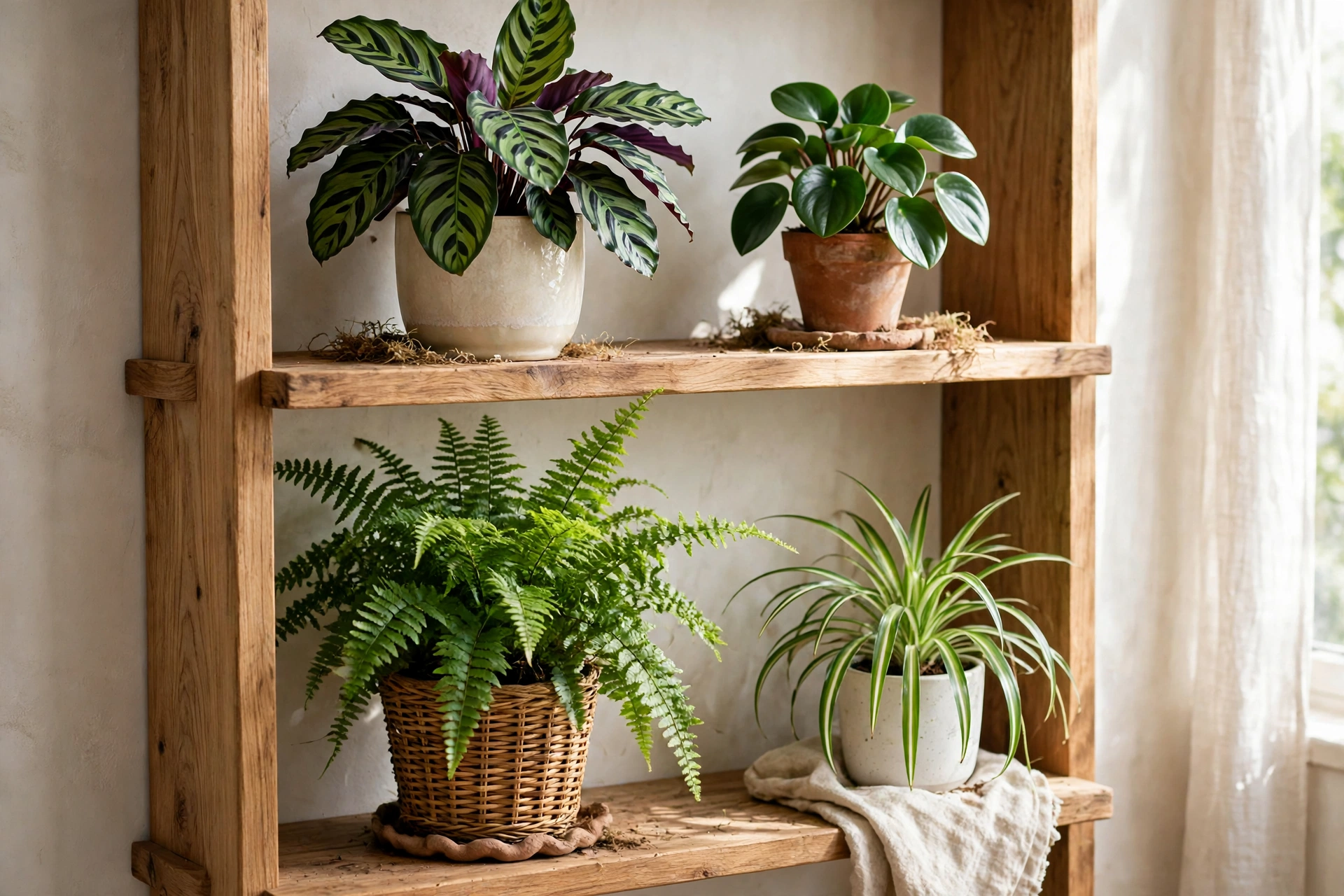
The list at a glance — all 25, each checked non-toxic to cats and dogs:
| Plant | Type | Light | Water |
|---|---|---|---|
| Spider Plant | Trailing | Bright to medium | Weekly |
| Boston Fern | Lush | Medium | Keep moist |
| Bird’s Nest Fern | Lush | Medium | Even moisture |
| Calathea & Prayer Plants | Patterned | Medium | Keep moist |
| Cast Iron Plant | Lush | Low to medium | Let it dry |
| Parlor Palm | Palm | Low to medium | Even moisture |
| Areca Palm | Palm | Bright | Even moisture |
| Money Tree | Statement | Bright indirect | When top inches dry |
| Ponytail Palm | Statement | Bright | Rarely — it stores water |
| Kentia Palm | Palm | Low to medium | Even moisture |
| Peperomia | Shelf | Bright indirect | Let dry between drinks |
| Hoya | Trailing / climbing | Bright | Lean watering |
| Burro’s Tail | Trailing succulent | Bright | Rarely |
| Chinese Money Plant | Shelf | Bright indirect | When top inch dries |
| Air Plants | No-soil | Bright indirect | Mist or soak weekly |
| Lipstick Plant | Trailing | Bright | Let the top dry |
| Swedish Ivy | Trailing | Bright indirect | Regular |
| Friendship Plant | Shelf / terrarium | Medium | Keep moist |
| Nerve Plant | Terrarium | Medium | Keep moist |
| Haworthia | Succulent | Bright | Rarely |
| Echeveria | Succulent | Brightest window | Rarely |
| African Violet | Flowering | Bright indirect | Water from below |
| Phalaenopsis Orchid | Flowering | Bright indirect | Weekly soak |
| Christmas Cactus | Flowering | Bright | Moderate |
| Polka Dot Plant | Shelf | Bright | Even moisture |
Lush and leafy: the green backbone
Spider Plant (Chlorophytum comosum)
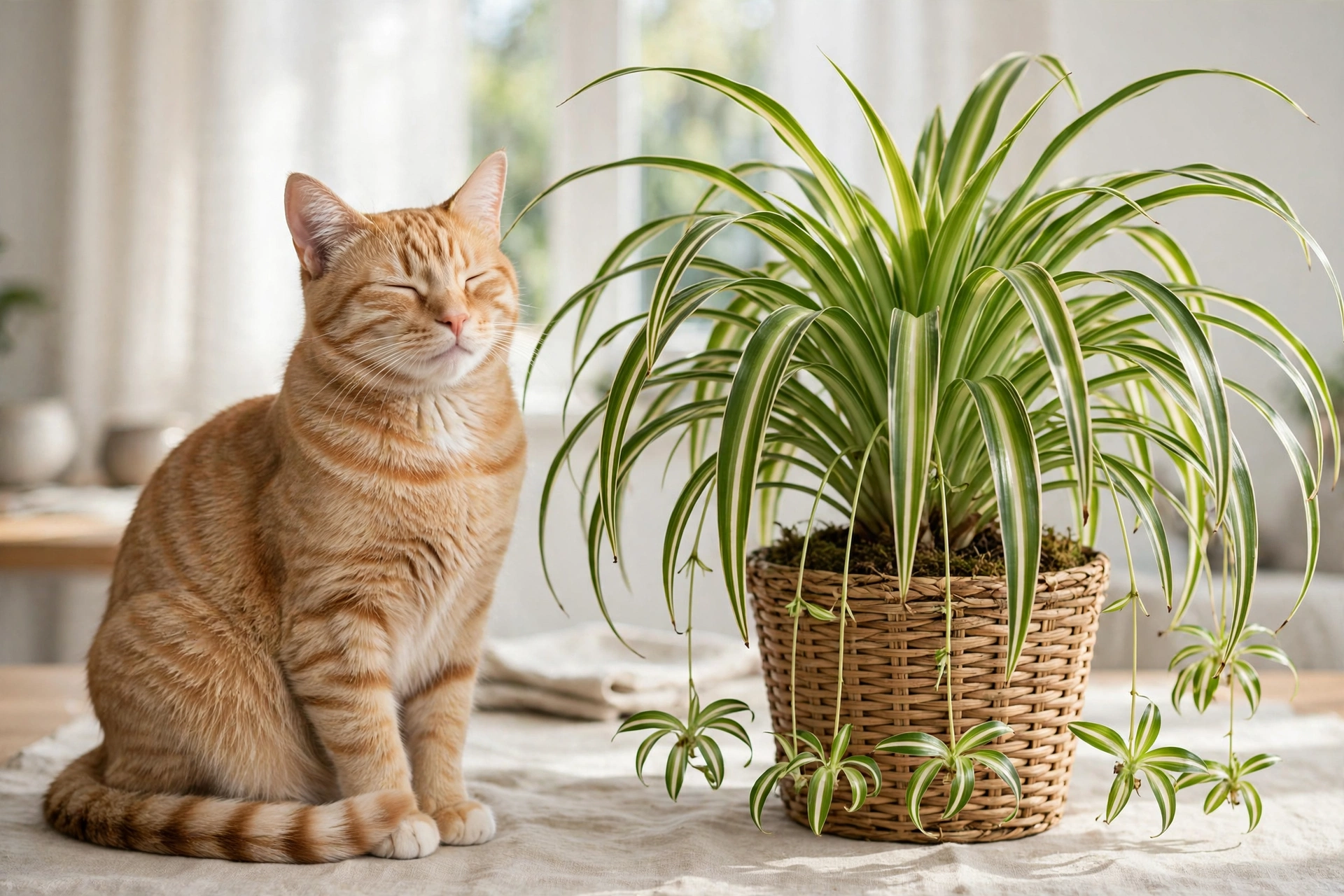
The most forgiving plant on this list and the one cats love most — those arching, striped leaves are cat magnets, and the dangling babies are irresistible. Non-toxic, unbothered by attention, and happy in bright to medium light with a weekly water. Our spider plant care guide has the full routine.
Boston Fern (Nephrolepis exaltata)
The classic lush fern: soft, arching fronds for hanging baskets and bathroom shelves. Non-toxic to cats and dogs. Wants humidity and consistently moist soil — the highest-maintenance entry here, and worth it in a steamy bathroom.
Bird’s Nest Fern (Asplenium nidus)
Broad, ripple-edged fronds unfurling from a central rosette, with none of the shedding fuss of finer ferns. Non-toxic. Medium light, even moisture, and never water into the center rosette.
Calathea and Prayer Plants (Calathea, Goeppertia, and Maranta)
The pattern department: painted leaves in greens, pinks, and creams, several folding their leaves up at night. The whole group is non-toxic to cats and dogs. They like medium light, steady moisture, and humidity — fussy about water quality, safe around pets.
Cast Iron Plant (Aspidistra elatior)
The plant for the dark corner and the forgetful owner: deep green leaves, famously indestructible, tolerant of low light and missed waterings. Non-toxic, and possibly the best effort-to-effect ratio on this page.
Palms and statement plants
Parlor Palm (Chamaedorea elegans)
The Victorian favorite and the safest palm name to remember: small, graceful, tolerant of low light, non-toxic to cats and dogs. Slow-growing — buy the size you want.
Areca Palm (Dypsis lutescens)
The big, feathery floor palm for a bright corner. Non-toxic. Wants more light and water than the parlor palm and gives you a small tree’s worth of green in return.
Money Tree (Pachira aquatica)
Braided trunk, hand-shaped leaves, floor-plant presence. Non-toxic to cats and dogs. Bright indirect light and a drink when the top couple of inches dry. (The name promises luck; the safety is the verified part.)
Ponytail Palm (Beaucarnea recurvata)
A swollen, bottle-shaped trunk topped with a fountain of thin leaves — more sculpture than plant. Despite the name it is not a true palm but a succulent relative, and it stores water in that trunk: bright light, rare watering. Non-toxic to cats and dogs.
Kentia Palm (Howea belmoreana)
The elegant, slow-growing palm of hotel lobbies and Victorian parlors, and the low-light champion of the palm group. Expensive for its size because it grows so slowly — but non-toxic, graceful, and tolerant of dim corners the others refuse.
Trailing and shelf plants
Peperomia (Peperomia species)
A whole shelf of variety — watermelon-striped, ripple-leafed, trailing — and the genus is non-toxic to cats and dogs. Most types want bright indirect light and a dry-out between waterings; several are small enough for desks and bookshelves.
Hoya (Hoya carnosa and relatives)
Waxy leaves, trailing or climbing vines, and — with patience and bright light — clusters of star-shaped flowers. Non-toxic. Treat it like a light succulent: bright light, lean watering.
Burro’s Tail (Sedum morganianum)
Cascading ropes of plump blue-green beads for a high shelf or hanging pot. Non-toxic to cats and dogs — but brittle: knocked stems shed leaves, so hang it where tails and paws cannot reach for the plant’s sake, not the pet’s.
Chinese Money Plant (Pilea peperomioides)
Coin-round leaves on slender stems, endlessly photogenic, and a generous producer of pups to share. Non-toxic. Bright indirect light and a quarter-turn weekly keeps it symmetrical.
Air Plants (Tillandsia species)
No soil, no pot, endless display options on shelves, driftwood, and frames. Non-toxic — though their spiky, nest-like shape makes them look like cat toys, so display them where a determined cat cannot carry one off. Mist or soak weekly.
Lipstick Plant (Aeschynanthus species)
Trailing stems of glossy leaves ending in clusters of red, tube-shaped flowers that emerge from dark buds — the lipstick still in its tube. Non-toxic. Bright light for flowers; let it spill from a basket.
Swedish Ivy (Plectranthus australis)
Neither Swedish nor an ivy: a fast, friendly trailer with scalloped leaves that fills a hanging basket within a season. Non-toxic to cats and dogs. Bright indirect light, regular water, and pinch the tips to keep it full.
Friendship Plant (Pilea involucrata)
Deeply quilted, bronze-green leaves with a metallic sheen — the textured one of the group. Non-toxic. It loves humidity, so it thrives in bathrooms and terrariums where other plants sulk.
Nerve Plant (Fittonia verschaffeltii)
Tiny leaves netted with white, pink, or red veins — a terrarium staple, and the most dramatic faint-er in the plant world: it collapses when thirsty and revives within hours of a drink. Non-toxic. Keep the soil evenly moist and the humidity up.
Succulents that are actually safe
Haworthia (Haworthia species)
The aloe look-alike you want: tight rosettes with white banding, tiny footprint, very low water needs — and, unlike aloe, non-toxic to cats and dogs. See the look-alike traps below; this pair causes more confusion than any other.
Echeveria (Echeveria species)
Perfect geometric rosettes in dusty blues, greens, and pinks. Non-toxic. Needs your brightest windowsill and a very lean hand with the watering can.
Flowering, and safe
African Violet (Saintpaulia)
Velvet leaves and flowers in purples, pinks, and whites for months at a time under bright indirect light. Non-toxic to cats and dogs. Water from below to keep the fuzzy leaves spotless.
Phalaenopsis Orchid
The supermarket orchid — and yes, genuinely non-toxic to cats and dogs. Blooms last for months; the standard routine (weekly soak, bark mix, bright indirect light) is all it asks.
Christmas Cactus (Schlumbergera)
Arching, segmented stems and winter flowers in red, pink, or white. Non-toxic — and do not let the name worry you: the dangerous “lilies” of the holiday season are a different plant entirely (see the traps). Bright light, moderate water.
Polka Dot Plant (Hypoestes phyllostachya)
Small, cheerful leaves splashed pink, white, or red — often sold in the novelty-plant section, which undersells it. Non-toxic. Bright light keeps the spots bold; pinch tips to keep it bushy.
The look-alike traps: where pets actually get hurt
Common names lie. These are the confusions that send pets to vets:
- Haworthia (safe) vs Aloe vera (TOXIC). Both are spiky rosettes on a windowsill. Aloe contains saponins and is on the ASPCA toxic list for cats and dogs — vomiting, lethargy, diarrhea. If it is plump, plain green, and gel-filled, it is not the safe one.
- Echeveria (safe) vs Jade Plant (TOXIC). Two succulent rosette-and-stem favorites; jade (Crassula ovata) is toxic to cats and dogs. Check the label’s Latin name, not the shape.
- Christmas Cactus (safe) vs “Lilies” (DEADLY to cats). True lilies (Lilium) and daylilies (Hemerocallis) can cause fatal kidney failure in cats from even a bite or licked pollen — the single most dangerous flower group for cats. Peace lilies and calla lilies are not true lilies but are still toxic (calcium oxalates). Any plant with “lily” in its name deserves a database check before it crosses a cat home’s threshold.
- Parlor and Areca Palms (safe) vs Sago Palm (DEADLY). The sago palm is not a true palm but a cycad, and every part — seeds worst of all — carries cycasin, which causes liver failure in dogs and cats. It is the most dangerous common “palm” sold. Never guess a palm: check the Latin name.
- Boston Fern (safe) vs Asparagus Fern (TOXIC). The asparagus fern is not a true fern; its berries and foliage cause stomach upset and skin irritation. Fine, feathery foliage on a plant labeled Asparagus setaceus is the warning sign.

Popular plants that are NOT pet-safe
Honesty section: several of the most-loved houseplants are on the ASPCA toxic list for cats and dogs, usually because of calcium oxalate crystals or saponins. If you have them, they need the placement management covered in our pothos safety guide — is pothos toxic to cats is the full breakdown for the most common one. The list:
- Pothos and satin pothos (calcium oxalates)
- Monstera (calcium oxalates)
- Philodendron (calcium oxalates)
- Snake plant (saponins)
- ZZ plant (calcium oxalates)
- Dracaena species (saponins)
- Dieffenbachia (calcium oxalates, among the most painful)
- Fiddle-leaf fig and other Ficus (irritant sap)
- Aloe vera and jade plant (see the traps above)
- True lilies and daylilies — cats: potentially fatal; sago palm — cats and dogs: potentially fatal
If your pet eats a plant — safe list or not
“Non-toxic” is not the same as “food.” The ASPCA itself notes that eating ANY plant material can cause vomiting and stomach upset in cats and dogs — a bellyful of spider plant is a bad afternoon, not an emergency, but it is still worth a call if signs persist. For a plant on the toxic list, or any plant you cannot identify: remove leftover plant material, note what and how much was eaten, and call your vet or ASPCA Animal Poison Control on (888) 426-4435 (a consultation fee may apply). Photograph the plant — identification drives everything.
Pet-safe plant questions, answered
Can I trust a “pet-friendly” label in a store?
Treat it as a hint, not a verdict. There is no regulated standard behind the label, and it is applied to common names — which, as the traps section shows, are exactly where the danger hides. The 30-second habit that actually protects your pet: read the Latin name on the label, and check that name in the ASPCA database before the plant goes in the cart.
If a plant is safe for dogs, is it automatically safe for cats?
No — the lists overlap heavily but are not identical, and the famous exception is the important one: true lilies are catastrophic for cats yet far less dangerous to dogs. It also runs the other way for a few plants. That is why every entry on this page was required to be non-toxic to BOTH. When you check a new plant, check it for your actual animal.
My cat eats the spider plant constantly. Is that okay?
Toxicologically, yes — spider plants are non-toxic, and cats famously adore them, possibly for their mild grass-like appeal. Practically: a cat eating a lot of any foliage may vomit it back up, and your plant will look chewed. The standard peace treaty is a pot of cat grass on the floor as the legal option, and the spider plant hung where it can trail in peace.
Why is the fiddle-leaf fig not on this list? It is in every home store.
Because it does not pass the check: Ficus species, including the fiddle-leaf fig, are on the ASPCA toxic list for cats and dogs — their sap carries irritants that cause mouth and stomach upset and skin irritation. Popularity is not safety data. If you love the look, the money tree gives you the same big-leaf, floor-plant presence from the safe list.
Do I still need to keep pet-safe plants out of reach?
For poison, no — that is the point of the list. For everything else, a little sense helps: dogs dig, cats knock pots off shelves, and fertilized soil is not a snack for anyone. Keep the plants where they will thrive and stay upright, use plain potting mix without added pesticide granules where pets can dig, and let the safety list handle the chemistry.
Are any herbs safe to grow around cats and dogs?
The pet-specific ones, certainly: cat grass (young oat, wheat, or barley grass) and catnip are grown FOR cats. For culinary herbs, check each by name the same way as any plant — several common ones are fine and a few are not, and oils and concentrated extracts are a different risk category from a living herb. The ASPCA database covers them all; thirty seconds per plant is the whole method of this page.


One Comment