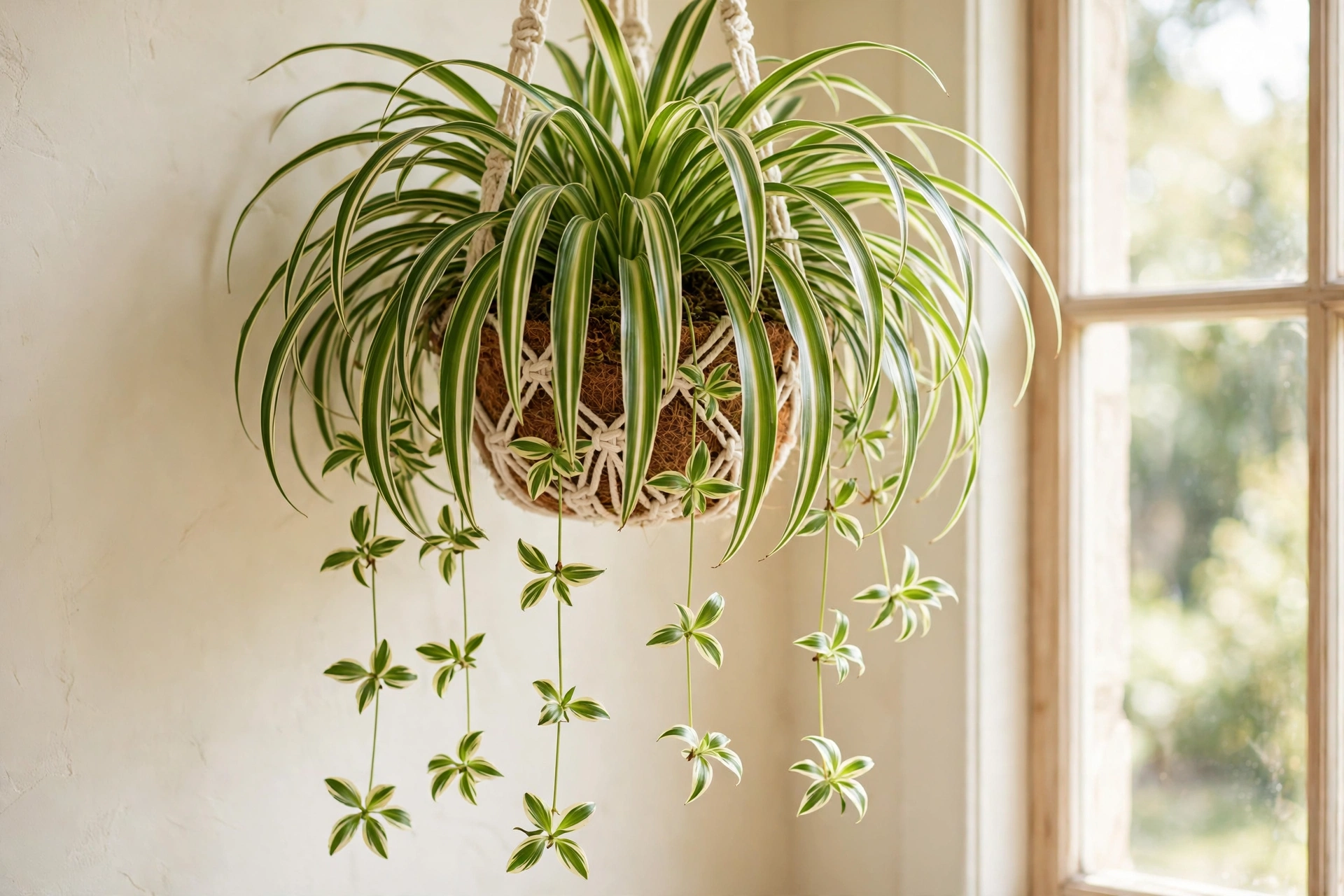
Spider Plant Care Guide: Light, Water, Soil & Fixes
The spider plant is supposed to be the easy one — and yours probably is easy, right up until you look at the leaf tips. Brown. Crispy. On nearly every leaf, spreading a little further each month, while the plant itself grows happily on and throws out babies like nothing is wrong. You water it, you feed it, you move it around the room. The brown tips stay.
Here is what almost nobody tells you: those brown tips are usually not your fault, and they are not really about care at all. They are about your tap water. Good spider plant care is genuinely simple — bright light, a drink when the surface dries, a snug pot — plus one water-quality trick this guide will explain. Get that right and this becomes the most generous plant you own: fast, forgiving, safe around pets, and forever making free babies to give away.
Quick Answer
Give a spider plant bright, indirect light, water when the top inch of soil dries, and plant it in loose, well-draining soil in a pot it can fill snugly. If the leaf tips brown, switch to rainwater or distilled water — spider plants are unusually sensitive to the fluoride in tap water. Feed lightly once a month in spring and summer, keep it above 50°F, and let it make babies: it wants to.
Table of Contents
Quick Care Card — Spider Plant (Chlorophytum comosum)
| Botanical name | Chlorophytum comosum |
| Light | Bright, indirect light keeps the stripes bold; tolerates shade, fades there |
| Water | When the top inch of soil dries; rainwater or distilled if tips brown |
| Soil | Loose, loamy potting mix with sharp drainage |
| Temperature | 60–80°F suits it; will not tolerate below 50°F |
| Humidity | Average rooms are fine; prefers 50–60% |
| Fertilizer | Light — once a month at most in spring and summer; overfeeding burns tips |
| Pet safety | Non-toxic to cats and dogs (ASPCA) — one of the safest houseplants |
Light: bright enough to keep the stripes
A spider plant’s variegation is a light meter you can read at a glance. In bright, indirect light, the cream-and-green stripes stay crisp and growth is fast and full. In a dim corner the plant survives — it is genuinely shade-tolerant — but new leaves come in plainer, greener, and sparser, as the plant maximizes what chlorophyll it can. Direct hot sun is the other failure mode: it scorches the leaves into bleached patches.
The sweet spot is a bright windowsill with the sun filtered or off to the side — an east window, or a few feet back from a south or west one. This is also one of the best bathroom plants going: bright, humid air suits it perfectly. In a hanging basket or on a high shelf, the arching leaves and dangling babies show at their best — and, not incidentally, mostly out of reach of grazing cats.
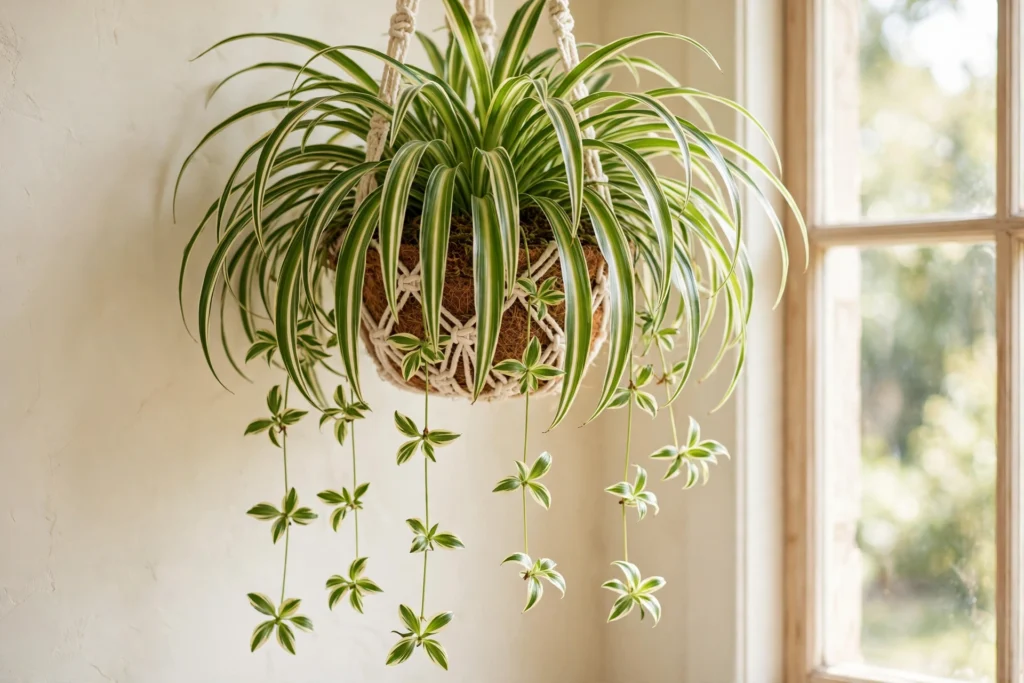
Field tip: If your spider plant’s stripes have washed out over the winter, do not feed it — move it. Variegation returns with light, leaf by leaf, on the new growth.
Water: the brown-tip mystery, solved
Water the soil the simple way: when the top inch has dried, soak the pot until water runs from the holes, empty the saucer, and repeat when it dries again — roughly weekly in summer growth, less in winter. The plant’s thick, tuberous roots store water, so a forgotten week harms it far less than a constantly soggy pot, which rots those same roots.
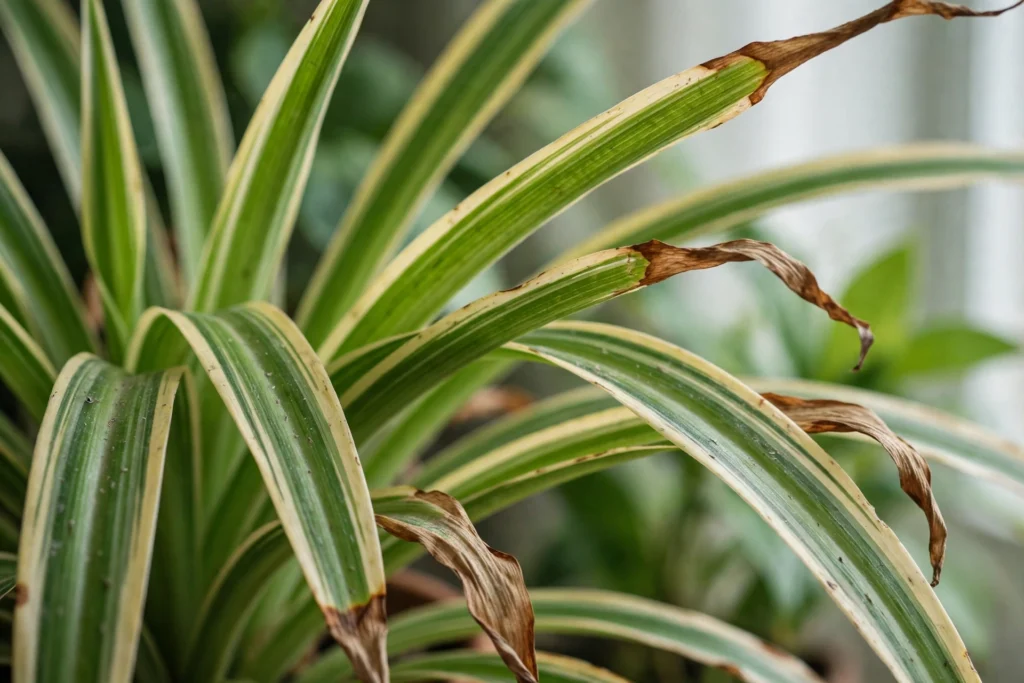
Now the part that matters. NC State Extension lists the spider plant as susceptible to tip burn from fluoride and chlorine in tap water, and a HortScience study confirmed it directly: apply fluoride, and spider plant tips burn. Here is the mechanism, because once you see it, every brown tip makes sense — the plant moves water out to the far end of each long leaf, dissolved minerals accumulate at the tip faster than the tissue can handle, and the very end burns. It is slow and cumulative: months of perfectly good care on fluoridated tap water still writes brown on every tip.
The fixes, in order of reliability:
- Rainwater or distilled water. The complete answer — no fluoride, no chlorine, no salts.
- Flush the pot. Every few months, run plain water through the soil several times to wash out accumulated salts.
- Feed less. Fertilizer salts add to the same buildup; this plant needs little food anyway.
And one popular half-measure, handled honestly: letting tap water stand overnight lets chlorine gas off, but fluoride does not evaporate — it stays. A standard charcoal jug filter does not remove fluoride either. If tips keep browning on rested or filtered water, the water is still the problem, and rain or distilled is the real fix. The existing brown tips will not heal — trim them off with clean scissors, following the leaf’s natural taper, once the cause is fixed.
Soil and the pot: loose, snug, and draining
Spider plants are unfussy about soil: any loose, loamy houseplant mix with good drainage serves, ideally around neutral pH. A standard mix with a handful of perlite stirred in is all the engineering required. Drainage holes are, as ever, non-negotiable.
The pot strategy is where spider plants differ from most: they like to be snug. A slightly rootbound plant is a plant putting its energy into leaves and babies rather than root expansion, and South Dakota State Extension notes these plants produce babies when rootbound. Repot only when the thick roots lift the plant in its pot, crowd the surface, or — eventually — threaten to crack the pot itself, roughly every two to three years, and then only one size up.
Temperature and humidity
Keep it in the human comfort zone: 60–80°F, and never below 50°F, which damages the foliage. Protect it from cold drafts and the blast of air-conditioning vents. Humidity preferences are mild — it enjoys 50–60% but manages average rooms without drama; very dry heated winter air contributes to tip browning, which is one more reason the bathroom shelf and the humidifier earn their place. Wipe leaves occasionally; the long straps collect dust along their grooves.
Fertilizer: the light touch
This is a light feeder with a warning attached: overfeeding is one of the causes of the brown tips everyone blames on water alone. Fertilizer salts accumulate in the soil exactly the way tap-water minerals do. A balanced houseplant feed at half strength, once a month at most in spring and summer, is plenty — several extension services suggest even less, every few months. Skip winter entirely, and flush the pot with plain water a few times a year to keep salts from building.
Propagation: the plant that gives itself away
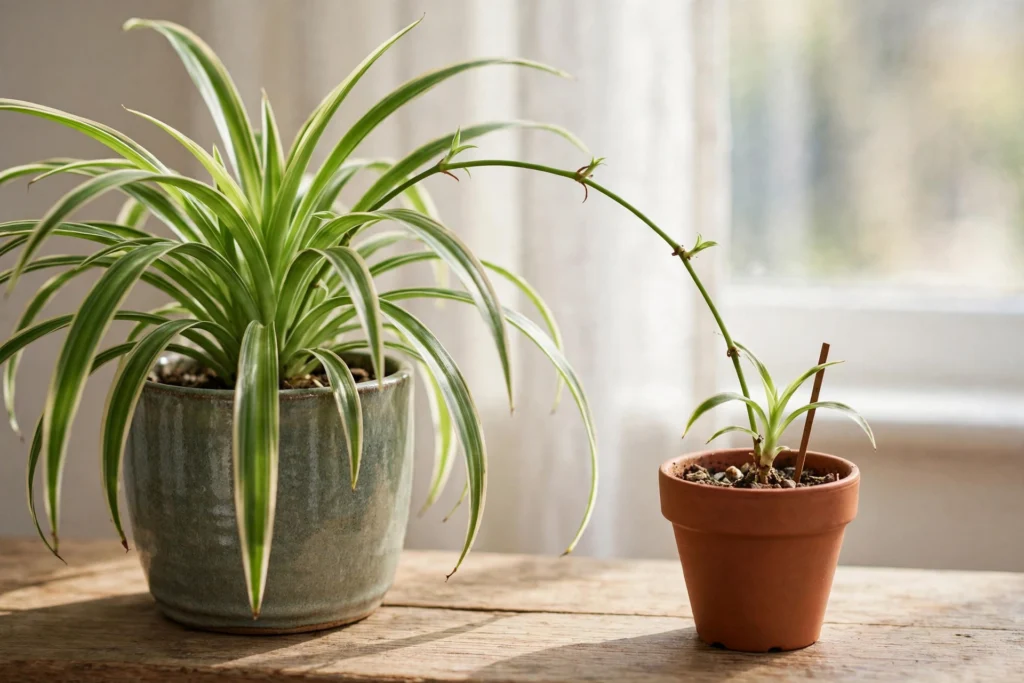
Spider plants propagate themselves with more enthusiasm than almost any plant you will own. A mature, slightly snug plant sends out long wiry stems — first carrying small white star-shaped flowers, then baby plantlets, the “spiders” that give the plant its name. Each plantlet is a complete new plant waiting for soil.
Pinning (easiest, nearly foolproof). While the plantlet is still attached to the mother, set a small pot of moist mix beside her and pin the plantlet onto the surface with a bent paperclip or hairpin. Keep the mix moist. In a few weeks it roots into its own pot; cut the connecting stem, and you have two plants. Attachment to the mother keeps the baby fed while it roots, which is why this method almost never fails.
Cut and root. Plantlets that have started forming little root nubs at their base can be snipped off and set straight onto moist soil, or stood in water until roots reach an inch or two, then potted. Either way, bright indirect light and steady moisture for the first month.
If your plant makes no babies at all, it is not broken — it is probably young, freshly repotted into too much room, or short on light. Babies are the hobby of a mature plant that feels snug and well-lit.
Common problems: what your spider plant is telling you
| What you see | Likely cause | What to do |
|---|---|---|
| Brown, crispy leaf tips | Fluoride and chlorine in tap water; also salts, very dry air | Switch to rainwater or distilled; flush the pot; feed less; trim tips once fixed |
| Brown tips AND mushy base | Overwatering — the roots are rotting | Unpot, cut away rot, repot in fresh mix; water less often |
| Stripes fading, leaves plain green | Too little light | Move to brighter indirect light; new growth will stripe again |
| Pale, washed-out leaves | Low light, or a hungry plant in season | Brighter spot first; then a light feed if it is spring or summer |
| No babies | Plant too young, pot too roomy, or light too low | Give it time, brightness, and a snug pot — babies follow |
| Leaves drooping and limp | Thirst, usually — check for soggy soil too | Water if dry; if wet, check roots before watering again |
| Sticky leaves, tiny white insects on stems | Mealybugs or aphids | Wipe off with a damp cloth or alcohol swab; repeat weekly |
| Fine webbing | Spider mites, encouraged by dry air | Wipe leaves, raise humidity, repeat weekly |
| Whole leaves yellowing | Age (outer leaves), or chronically wet soil | Remove spent outer leaves; check watering rhythm if it spreads |
That first row is the one to remember. On a spider plant, brown tips are a water-quality report, not a verdict on your care — the distinction matters, because the fix is in your water jug, not your watering can habits.
Varieties worth knowing
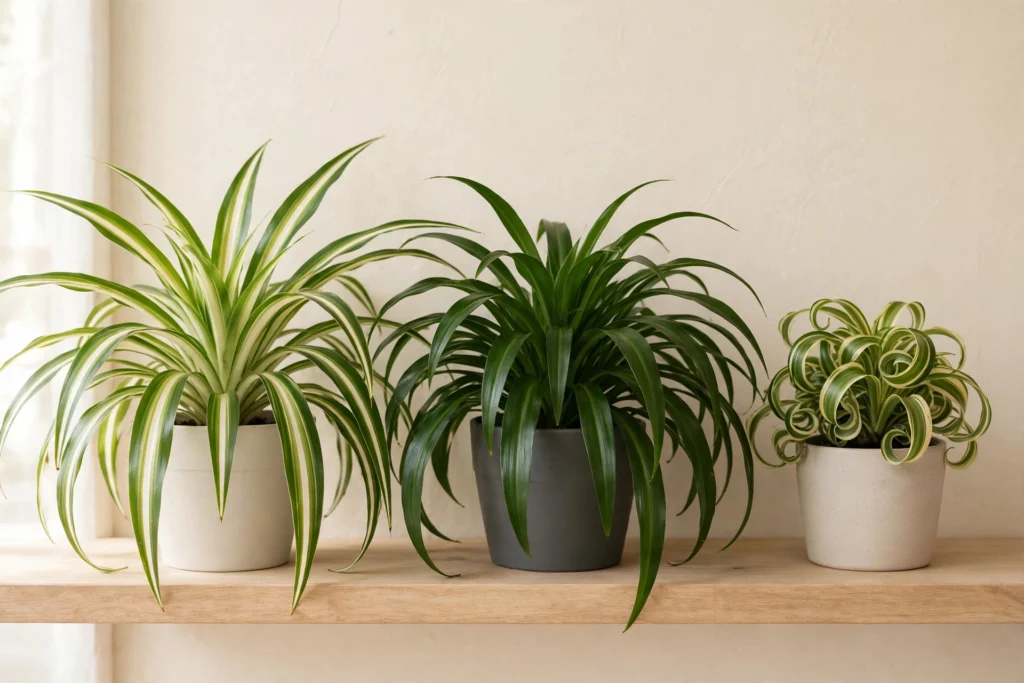
- ‘Vittatum’ — the classic: a broad cream-white stripe down the center of each leaf, green at the edges. The one in every hanging basket since forever.
- ‘Variegatum’ — the inverse: green center, cream margins. Slightly slower, wants bright light to hold its contrast.
- ‘Reverse Variegatum’ — as the name says, a reversed pattern on a vigorous plant.
- ‘Bonnie’ — the curly spider plant: leaves that twist and curl as they arch, with the same cream striping. Compact and playful.
- The solid green form — no stripes at all, just deep green straps. Unfashionable for decades and quietly the toughest of the lot; it also keeps its looks in lower light than the striped types.
Pet safety: the genuinely safe one
After the warnings in our earlier guides, this section gets to be the relief: the ASPCA lists the spider plant as non-toxic to cats and dogs. It contains no oxalate crystals and no saponins of concern — you can hang it in a cat household without the shelf-height calculations the pothos, snake plant, and monstera demand. Cats do love batting and chewing the dangling leaves and babies (the plant is sometimes said to attract them almost like catnip), and eating any plant material can give a pet a mildly upset stomach — but this one is not a poisoning risk. It anchors our pet-safe houseplants list, and it is the plant we suggest first to anyone whose cat has already sampled the collection.
The monthly rhythm
Spider plants run on almost nothing: a weekly soil check, a monthly glance for babies worth pinning, a flush of plain water every few months to keep the salts down, and rain or distilled water if your tap is fluoridated. In return you get the fastest, most forgiving foliage in the house — and a production line of free plants. Pin a baby into a pot this month and by next season you will be giving them away, which is how spider plants have quietly colonized the world’s windowsills for a hundred years.
Spider plant care questions, answered
Why does my spider plant have brown tips?
Most often, your tap water. Spider plants are unusually sensitive to fluoride — NC State Extension names it directly, and controlled studies confirm fluoride burns their leaf tips. Chlorine, fertilizer salts, and very dry air contribute. The fix: rainwater or distilled, a pot flush every few months, and lighter feeding. Letting water stand overnight removes chlorine only; fluoride stays, which is why that trick half-works.
Is the spider plant safe for cats and dogs?
Yes — the ASPCA lists it as non-toxic to both. It is one of the safest houseplants you can own with pets. Cats often chew the leaves anyway, which can cause a mild stomach upset from eating plant material generally, but there is no toxin involved.
Why is my spider plant not making babies?
Babies come from mature plants that are slightly rootbound and getting good light. A young plant, one just repotted into a spacious pot, or one sitting in a dim corner will grow leaves but skip the plantlets. Brighten its spot, leave it snug, and give it a season — the stems with their white flowers and dangling spiders follow.
How do I propagate a spider plant?
Pin a dangling plantlet onto a pot of moist soil while it is still attached to the mother plant; it roots in a few weeks, and then you cut the cord. Or snip a plantlet that has root nubs showing and root it in water or moist mix. It is the easiest propagation in the houseplant world — the plant has already done most of the work.
Does the spider plant really purify the air?
It was one of the stars of NASA’s 1989 Clean Air Study, where it removed formaldehyde and other compounds from sealed test chambers. In a real home with ordinary air exchange, you would need far more plants than anyone owns to match simply opening a window. Enjoy it as a beautiful, safe, generous plant — the air claim is a footnote, not a feature.
Can a spider plant live in low light?
It tolerates low light better than most — but “tolerates” means slower growth, plainer leaves as the variegation fades, and few or no babies. For the plant in the photos, bright indirect light is the real requirement. A dim corner is survivable; it is not a home.
Why are the leaves of my spider plant drooping?
Almost always thirst — the soil has dried beyond the surface inch. Water deeply and it recovers within hours. If the soil is wet and the plant still droops, suspect the opposite problem: roots sitting in soggy mix. Check before you water again.
Should I cut off the brown tips?
You can, once the cause is fixed — use clean scissors and follow the leaf’s natural pointed shape, leaving a hair of brown rather than cutting into green tissue, which just creates a new wound edge. Trimming is cosmetic; without the water fix, new tips will brown as fast as you trim the old ones.
How big does a spider plant get?
The leaf fountain reaches about 1–2 feet across and high, with leaves 12–18 inches long; the dangling stems with babies can trail considerably further from a hanging basket. It is a shelf-and-basket plant by design, and it fills its space within a season or two in good light.



2 Comments