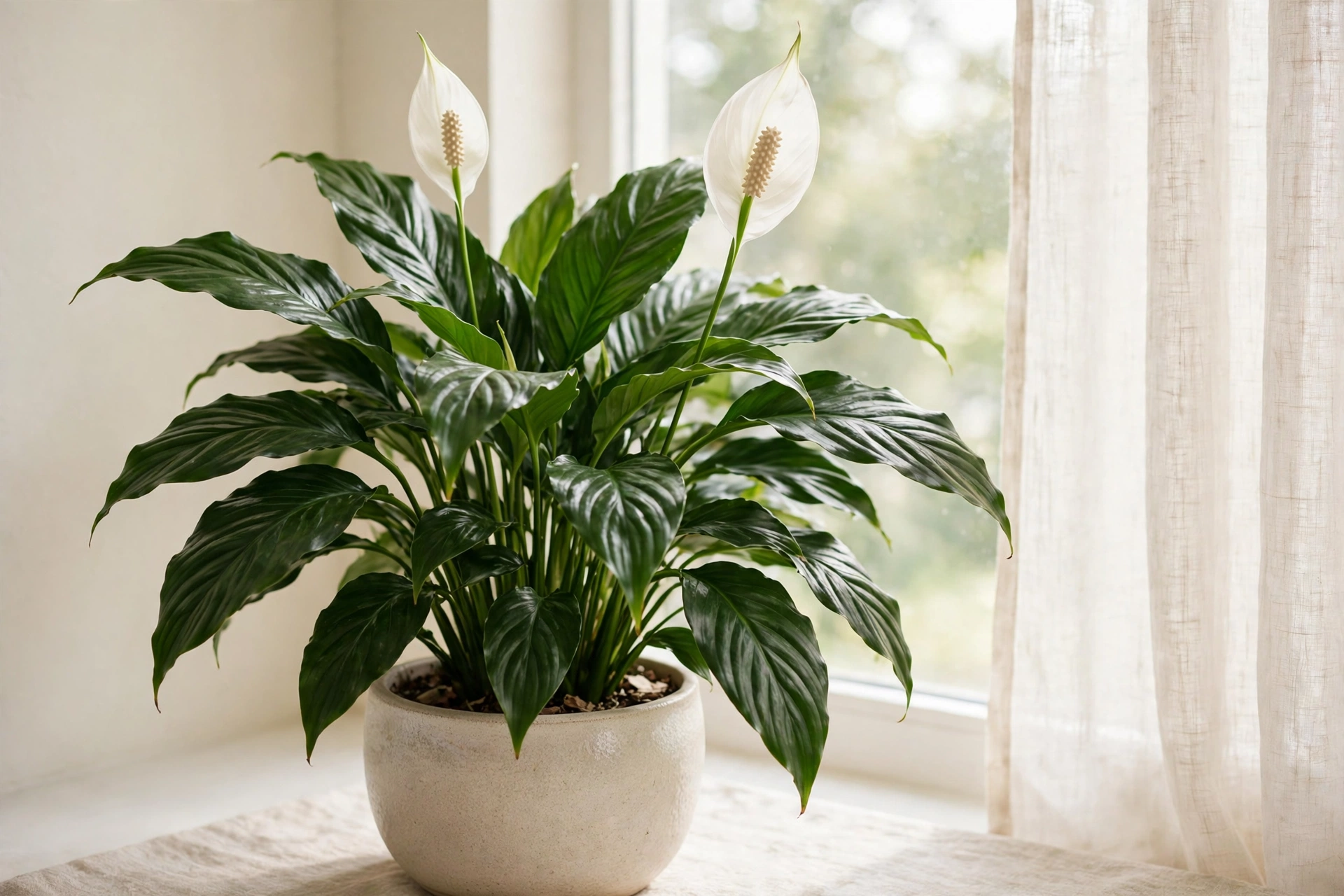
Peace Lily Care Guide: Light, Water, Soil & Fixes
It is the most dramatic plant in the house. One morning your peace lily stands tall and glossy; by evening it has collapsed over the rim of its pot like it has given up on life entirely. New owners panic. Experienced owners just water it — and by morning it is standing again, smug as ever. That theatrical droop is the peace lily’s party trick, and the reason people think it is an easy plant.
The harder truth shows up later: the plant that bloomed so reliably in the shop never flowers again, and its leaf tips crisp brown one by one. Those two complaints — no blooms, brown tips — are what this guide exists to solve. Good peace lily care is a specific rhythm: steady moisture, soft light, gentle feeding, and knowing how to read the droop before it becomes a habit.
Quick Answer
Keep a peace lily in bright, indirect light (it survives low light but flowers in brighter), water when the top inch of soil dries so the mix stays lightly moist, and never let it sit in water. Hold 65–80°F with decent humidity, feed very lightly in spring and summer, and water with filtered or rain water if the leaf tips brown. It will droop dramatically when thirsty and recover within hours — but do not make it perform that trick often.
Table of Contents
Quick Care Card — Peace Lily (Spathiphyllum)
| Botanical name | Spathiphyllum (a genus — most houseplants are hybrids; not a true lily) |
| Light | Bright, indirect light for blooms; tolerates low light, stops flowering there |
| Water | When the top inch dries; keep lightly moist, never soggy; droop means thirsty |
| Soil | Rich, organic potting mix that holds moisture yet drains freely |
| Temperature | 65–80°F; damage below 55°F, cold shows as blackened leaves |
| Humidity | Prefers 50–60%; dry air crisps the leaf tips |
| Fertilizer | Very light — quarter-strength feed every 6–8 weeks in the growing season |
| Pet safety | Toxic to cats and dogs (ASPCA) — see the pet safety section below |
Light: enough to bloom, not enough to burn
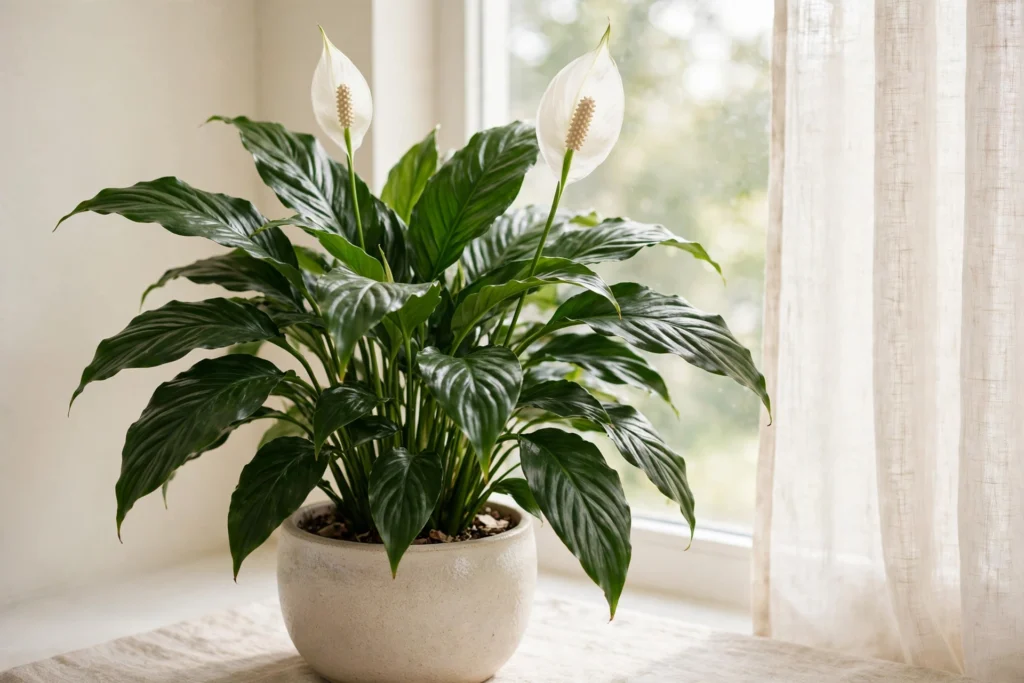
The peace lily’s reputation as a low-light plant is true and misleading in the same breath. It is one of the very few flowering plants that will live — genuinely live, for years — in the light of a dim hallway or a north-facing room. What it will not do there is flower. Extension services draw the line clearly: survival light and flowering light are two different amounts, and blooms need the brighter end of indirect.
Give it bright, indirect light: an east-facing window, a bright north window, or a spot a few feet back from south or west glass. Clemson Extension’s target for home culture is exactly that — bright and indirect. Direct sun scorches the broad leaves into pale, papery patches, and a plant getting too much light overall answers with curled, washed-out foliage, which is its way of asking for shade. If yours has not bloomed since it came home, the first fix is not food or water. It is a brighter address, reached gradually over a week so the leaves can adjust.
Water: reading the famous droop
This plant talks. When a peace lily is thirsty, the whole plant wilts at once — every leaf stalk softens and the canopy folds down. Water it thoroughly and it stands back up within a few hours, an honest resurrection. It is the clearest thirst signal in the houseplant world, and the worst way to run the plant: repeated collapse-and-recovery cycles stress it, age the leaves early, and brown the edges.
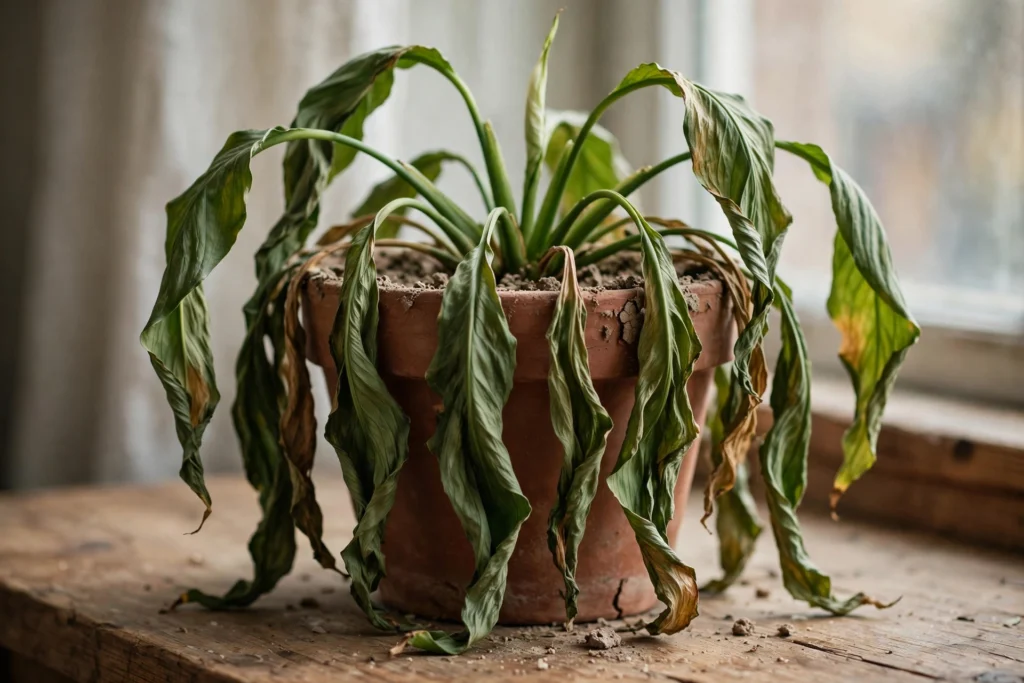
Run it on the soil instead. NC State Extension’s line is the right one: keep the mix moist but not waterlogged, let the surface dry slightly between waterings, then water thoroughly until it drains freely — and empty the saucer, because roots in pooled water deteriorate fast. In practice: water when the top inch feels dry (often about weekly), soak, drain, done. The droop then becomes what it should be — an emergency backup alarm you rarely hear, not the schedule.
Two water-quality notes, because this plant shares the family sensitivity. Peace lilies brown at the tips from the fluoride and chlorine in tap water (the Royal Horticultural Society flags fluoride damage specifically) and from the salts of overfeeding. If tips crisp while everything else looks right, switch to filtered, distilled, or rain water and flush the pot — the same fix as our spider plant, for the same chemical reason.
Soil and the pot: moist, rich, and draining
A peace lily comes from the rainforest floor of Central and South America, and its mix should feel like it: rich and organic, holding moisture between waterings, but open enough that water never stagnates. A quality houseplant mix with compost or coir does the job; adding a little perlite keeps it breathing. The pot needs drainage holes, and the plant is happiest slightly snug — peace lilies bloom best when a little rootbound, and an oversized pot mostly adds wet soil the roots cannot reach.
Temperature and humidity
Warm and steady: 65–80°F, with Clemson’s guidance allowing up to 85°F in the day. Cold is the enemy in both directions — below 55°F the plant is damaged, and cold injury announces itself as blackened leaves days later. Keep it away from winter window glass, exterior doors, and the direct path of air-conditioning.
Humidity is the second half of the rainforest contract. It prefers 50–60%; in dry heated rooms the leaf edges and tips crisp even when the watering is right. A pebble tray (pot sitting above, not in, the water), a nearby humidifier, or a bright bathroom all work. Grouping it with other plants helps a little. What does not help much is misting — a moment’s damp leaves, then dry air again.
Fertilizer: restraint is the bloom strategy
More peace lilies are ruined by kindness at the feeding bottle than by neglect. NC State Extension recommends light feeding at quarter strength, with the soil flushed between applications — because over-fertilizing and the resulting salt buildup burn leaf tips and roots. A balanced houseplant feed at quarter strength every 6–8 weeks through spring and summer is the whole program; nothing in winter.
There is a second reason for restraint: a heavily fed peace lily puts its energy into leaves at the expense of flowers. If yours is lush, green, and bloom-free while sitting in decent light, an over-generous feeding hand is a suspect, not a solution.
Getting it to bloom
The white “flower” is not technically a flower at all — it is a spathe, a modified leaf, wrapped around the spike of tiny true flowers (the spadix). Each one lasts about a month, fading from white to pale green before it browns and can be cut away at the base. A healthy plant blooms most freely in spring, often with a smaller autumn repeat.
When a peace lily will not bloom, work through the causes in this order:
- Light. The overwhelming favorite. It needs bright indirect light to flower; dim corners give leaves only. Move it brighter, gradually.
- Maturity. Young, small plants and fresh divisions need a season of growth before they flower.
- Feeding balance. Starved plants bloom poorly; overfed plants grow leaves instead. Quarter-strength, in season, is the middle path.
- Steady moisture. Repeated drought-collapse cycles spend the plant’s energy on survival, not flowers.
Do that, and blooming returns on the plant’s own calendar — usually the following spring. There is no honest shortcut, and any product promising to force one is selling you the fertilizer burn in row three of the problems table.
Repotting and propagation: divide the clump
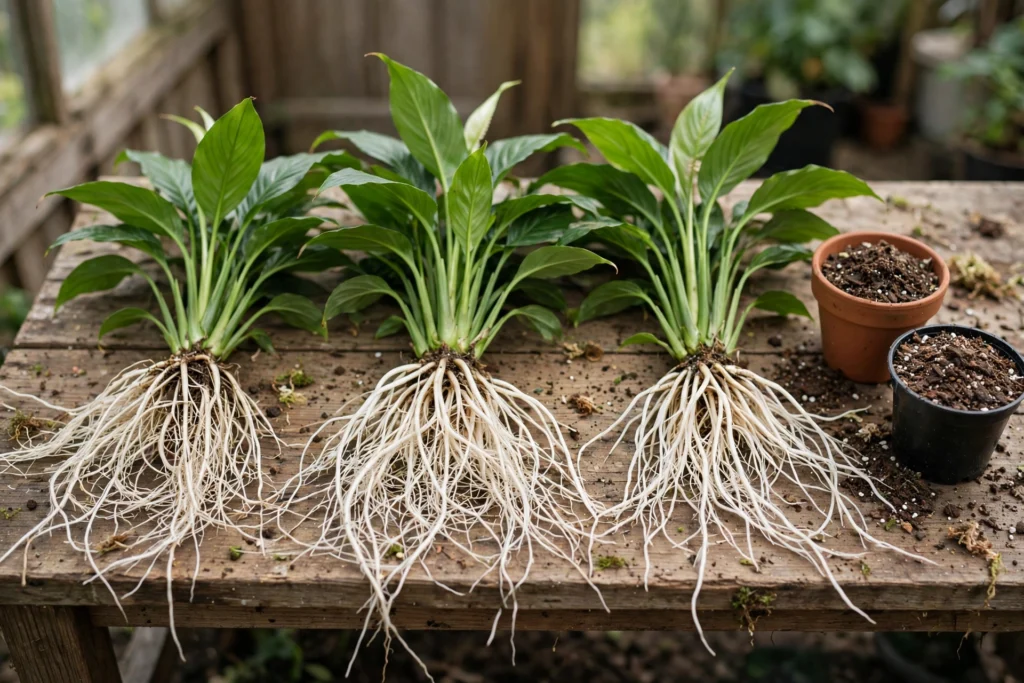
Peace lilies grow as clumps of crowns, and both jobs happen at once, in spring, roughly every one to two years — when roots circle the pot’s surface, water runs through too fast, or the plant droops again hours after every watering because the roots have displaced the soil.
- Water the day before. Tip the clump out and shake the roots mostly clean.
- To repot: move the whole clump up one pot size, at the same depth, in fresh rich mix. Water in well.
- To divide: tease or cut the clump into sections, each with its own crown of leaves and a fistful of healthy roots. Pot each section snugly, keep the mix moist and the light indirect while they settle — divisions often sulk and droop for days; steady moisture, not panic watering, brings them round.
Leaf cuttings do not work on this plant — there is no node trick here, the way there is with monstera. Division is the method, and a mature plant gives you several.
Common problems: what your peace lily is telling you
| What you see | Likely cause | What to do |
|---|---|---|
| Whole plant drooped flat | Thirst — almost always | Water thoroughly; it should stand within hours. If the soil was already wet, read the next row |
| Drooping with wet, sour soil | Root rot from overwatering | Unpot, cut black mushy roots, repot in fresh mix; water less |
| Brown, crispy leaf tips | Tap-water fluoride, dry air, or fertilizer salts | Switch water, flush the pot, raise humidity, feed weaker |
| Yellow leaves | Water stress either way; age; poor water quality | Check soil moisture first; remove fully yellow oldest leaves |
| No flowers, lush green plant | Light too low (then: overfeeding) | Brighter indirect spot, reached gradually; ease the feed |
| Flowers turning green | Natural aging of the spathe — sometimes excess light or feed | Normal: enjoy it, then cut the stalk at the base when it browns |
| Curled, pale, washed-out leaves | Too much light | Move back from the window or filter the sun |
| Blackened leaves | Cold damage below ~55°F | Move somewhere warm and draft-free; damaged leaves will not recover — new growth will tell the story |
| Tiny black flies around the pot | Fungus gnats in moist surface mix | Let the surface dry between waterings; our fungus gnats guide covers the full eviction |
Varieties worth knowing
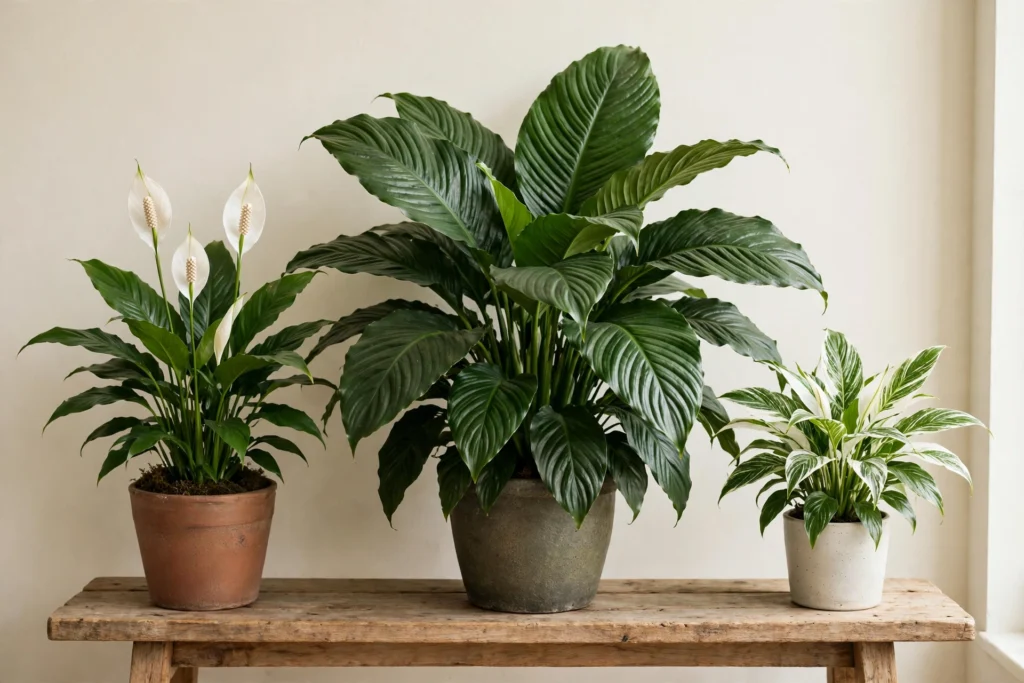
- ‘Mauna Loa’ — the classic florist’s peace lily: mid-size plant, generous white spathes, the one most homes start with.
- ‘Sensation’ — the giant: huge ribbed leaves and a plant that can reach several feet across. A floor statement, not a shelf plant.
- ‘Domino’ — leaves splashed and streaked with white variegation; a peace lily that looks interesting even out of bloom. Wants the brighter end of indirect light to hold its pattern.
- ‘Petite’ — a compact form for desks and small shelves, flowering at a modest size.
- Spathiphyllum wallisii — the smaller wild species behind many hybrids: daintier leaves and spathes, a heavy bloomer for its size.
Pet safety: toxic — but not a true lily
The ASPCA lists the peace lily as toxic to cats and dogs. Like its pothos and monstera cousins, it carries insoluble calcium oxalate crystals: chewing brings immediate burning and irritation of the mouth, drooling, vomiting, and sometimes difficulty swallowing. Call your veterinarian or the ASPCA Animal Poison Control Center at (888) 426-4435 if a pet chews it (a consultation fee may apply); the sap also irritates skin, so gloves for dividing are a good habit.
One clarification that genuinely matters, because the name causes real panic: the peace lily is not a true lily. It belongs to the arum family, and it does not cause the acute kidney failure that makes true lilies (Lilium and daylilies) a life-threatening emergency for cats. It will make a pet miserable and deserves respect and a high shelf — but it is not the lily of the veterinary warnings. Our full peace lily pet-safety guide untangles the two, and our pet-safe houseplants list has the worry-free alternatives.
The monthly rhythm
A peace lily’s care fits on one line: water when the top inch dries, keep it bright but never sunburned, feed it like you mean it only a little. Check it weekly with a finger in the soil, cut spent blooms at the base, and watch the newest leaves — glossy, upright, and unbrowned at the tips means the rhythm is right. This is the plant that teaches most people to garden by feel instead of by calendar, drooping its reminders and blooming its thanks. Treat it steadily, and it will out-flower everything else in the house.
Peace lily care questions, answered
Why is my peace lily drooping?
Because it is thirsty — that is the famous signal, and a thorough watering stands it back up within hours. The exceptions matter: if the soil is wet and the plant still droops, suspect root rot (unpot and check for black, mushy roots) or cold damage if it sat near a drafty window. And while an occasional droop is harmless, letting it collapse weekly stresses the plant — water on the soil’s schedule, not the plant’s theatrics.
Why won’t my peace lily bloom?
Light, almost every time. Peace lilies survive low light but flower only in bright indirect light — a plant in a dim corner can stay green for years without a single bloom. After light, check maturity (young plants need a season), feeding (too much fertilizer grows leaves instead of flowers), and steady moisture. Move it brighter gradually and expect flowers the following spring.
Is the peace lily really a lily? Is it deadly to cats?
It is not a true lily — it is an arum-family plant, a cousin of pothos and monstera. The ASPCA lists it as toxic: its calcium oxalate crystals cause mouth burning, drooling, and vomiting if chewed. But it does not cause the kidney failure that makes true lilies (Lilium) a life-threatening emergency for cats. Toxic and worth keeping away from pets — yes. The specific terror of the lily warnings — no.
How often should I water a peace lily?
When the top inch of soil has dried — about weekly in most homes, less in winter. Keep the mix lightly moist overall, water thoroughly until it drains, and always empty the saucer. Let the finger test, not the droop, set the schedule.
Why are my peace lily’s leaf tips brown?
Three usual causes, all slow and cumulative: fluoride and chlorine in tap water, dry indoor air, and fertilizer salt buildup. Switch to filtered or rain water, flush the pot with plain water, feed at quarter strength, and raise humidity if your rooms are dry. Trim the brown tips once the cause is fixed — they do not heal.
Why is my peace lily’s flower turning green?
Because it is aging. The white spathe naturally fades to pale green over its month of life, then browns; cut the stalk at its base when it looks spent. Strong light and heavy feeding can push spathes greener sooner — one more reason for the gentle regime. A green flower is not a sick plant.
Can I propagate a peace lily from a leaf cutting?
No — peace lilies have no stem nodes to root from, so a leaf in water just eventually rots. Divide the clump instead: at repotting, separate crowns with their own roots and pot each one up. Every division is a full plant, and a mature lily gives several.
Does the peace lily purify the air?
It was one of the most effective plants in NASA’s 1989 sealed-chamber study, and the claim follows it everywhere. In a real room, ordinary ventilation dwarfs what any plant can do — you would need a jungle to notice. Grow it for the flowers, the foliage, and the way it tells you when it is thirsty. That is plenty.
How big does a peace lily get?
Most home varieties finish between 1 and 4 feet tall and wide. The giant ‘Sensation’ breaks the rule entirely, reaching several feet across with leaves to match — check the label before you give a peace lily a small shelf and a big future.



One Comment