Best Soil Mix for Indoor Plants
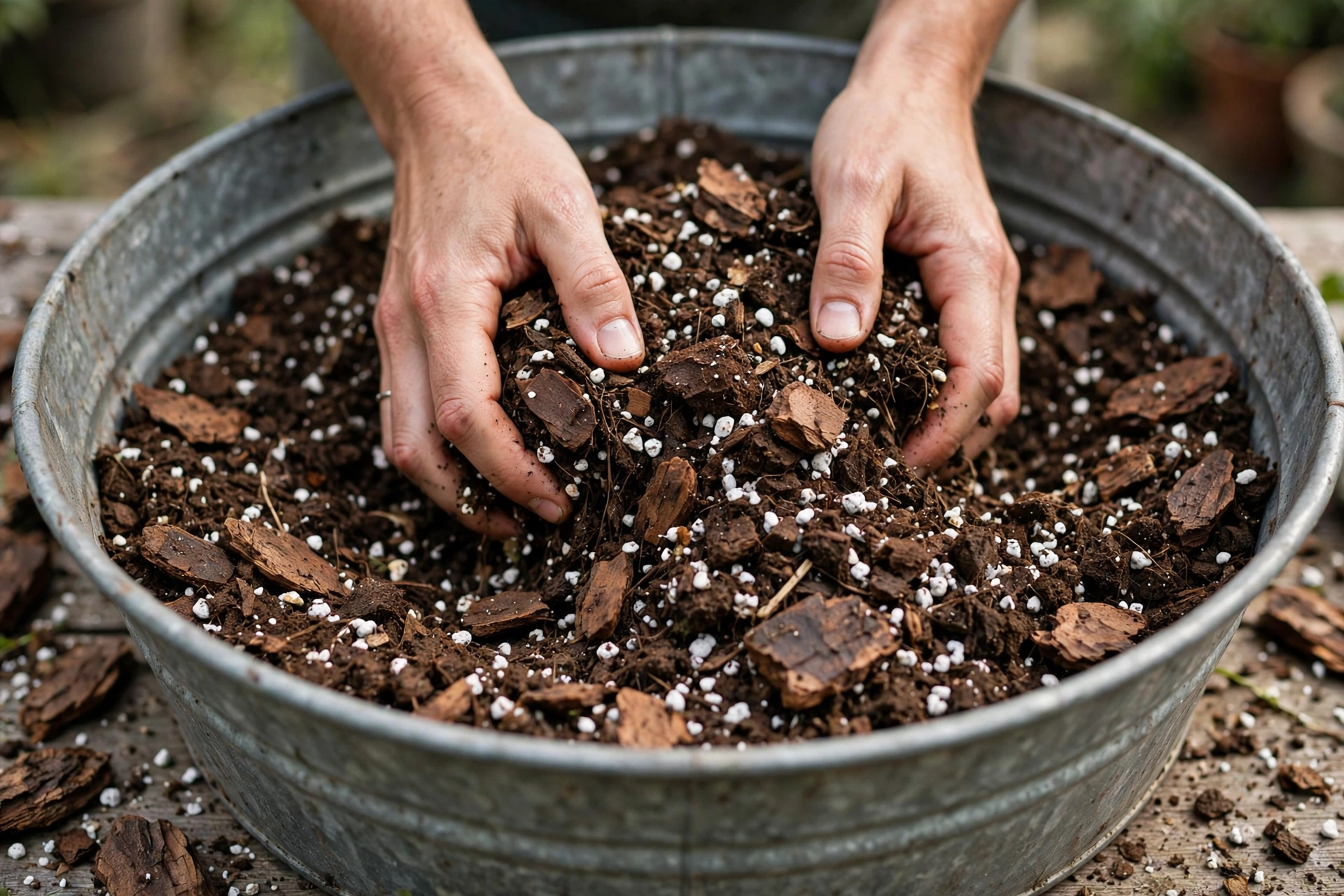
Here is the quiet truth behind half the problems on this site: most houseplants do not die of thirst, neglect, or bad luck. They die of soil — the dense, waterlogged brick that a cheap bag of potting mix slowly becomes, suffocating roots that needed air as much as water. Drooping, yellowing, fungus gnats, mold, root rot: read our problem guides and you will find the same accomplice in nearly every case.
The fix is not a premium bag. The best soil for indoor plants is not something you buy; it is something you mix — cheaply, in ten minutes, from three or four ingredients — and once you know the base recipe and how to bend it for different plants, you will never pour straight bagged soil into a pot again.
Quick Answer
The best soil for indoor plants, for most foliage plants, is a simple three-way mix by volume: 3 parts quality potting soil, 1 part orchid bark, 1 part perlite. The soil feeds and holds moisture; the bark keeps air pockets open; the perlite guarantees drainage. Then bend the ratio to the plant: chunkier and bark-heavier for monstera and other aroids, grittier and more mineral for succulents and snake plants, finer and more moisture-holding for ferns and calathea. The four variations are below.
Table of Contents
What roots actually need from a mix
A potting mix has four jobs, and bagged soil does two of them well and two badly:
- Hold water — enough, for a few days, not for a week and a half.
- Drain the excess — freely, out of the pot, within seconds of watering.
- Hold air — roots breathe; in a saturated, compacted mix there is no oxygen, and that is when rot organisms take over.
- Feed lightly — a gentle background of nutrition and biology (this is the easy job; fertilizer can top it up).
Peat- and coir-based bagged mixes start fluffy, but they break down and compact within a year, and when they dry out fully they can even repel water. The structural ingredients — bark and perlite — are what keep a mix performing in year two, not just month two. That is the entire secret: add structure.
The ingredients, and what each one does
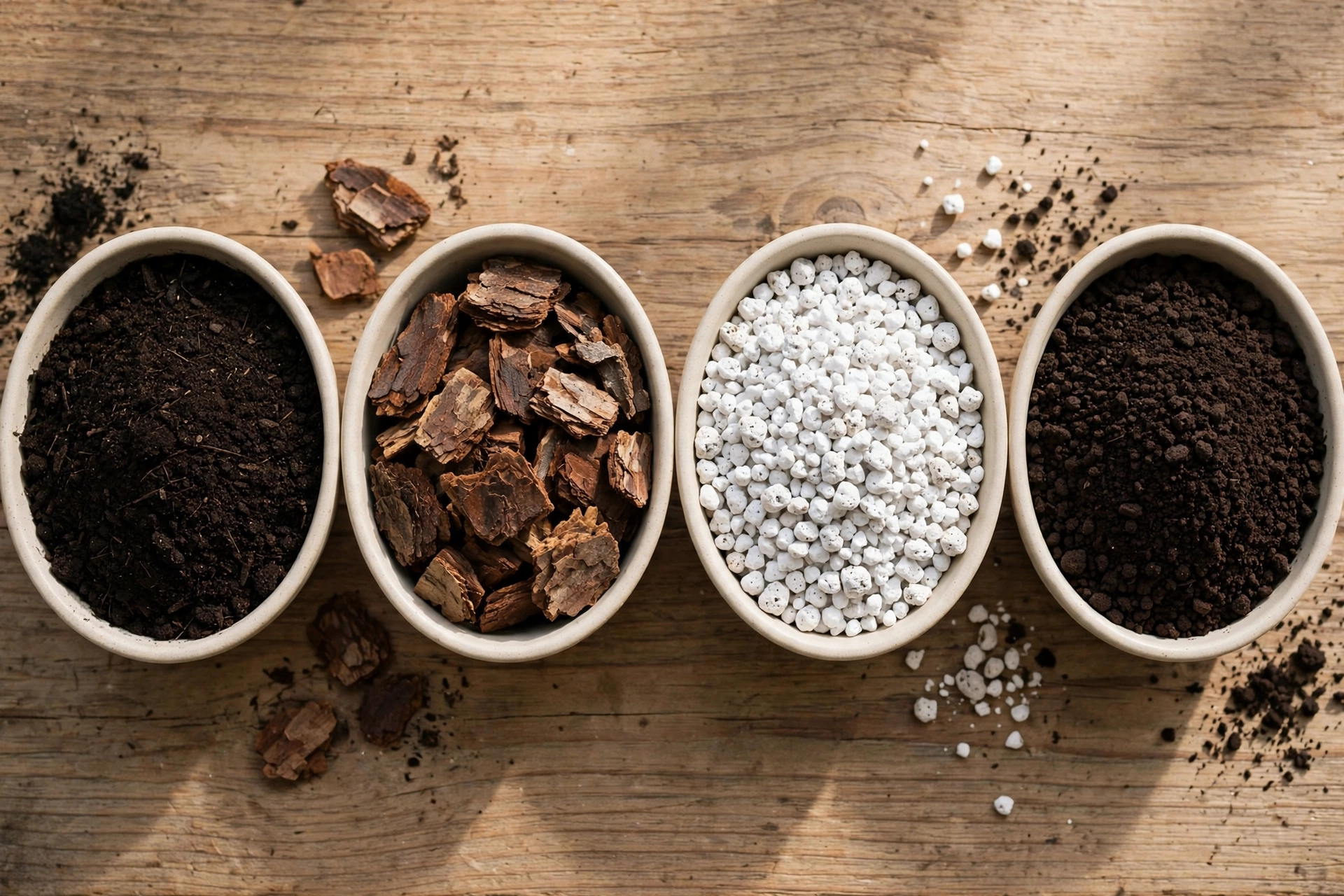
- Potting soil (the base): a decent peat- or coir-based indoor mix. This is the water-and-food reservoir. Buy plain and mid-priced; you are about to improve it anyway.
- Orchid bark: chunks of pine or fir bark, ideally ¼–½ inch. Creates lasting air pockets and drainage channels, and decomposes slowly. This is the ingredient that makes a mix “chunky.”
- Perlite (or pumice): the white volcanic pebbles. Pure drainage and aeration that never breaks down. Pumice does the same job with more weight (good for top-heavy plants) and less floating to the surface.
- Vermiculite: perlite’s opposite number — a mica mineral that holds water instead of shedding it. Swap part of the perlite for vermiculite in the moisture-lover variation if your ferns and calathea dry out too fast.
- Worm castings (optional but recommended): a handful per pot’s worth of mix adds gentle nutrition and living biology without burn risk. Think of it as seasoning, not a main ingredient.
- Horticultural charcoal (optional): a small handful in larger pots; traditionally used to keep mix “sweet” in containers that stay moist. Optional — the drainage does the real work.
One ingredient to leave out of general mixes: sand. Fine sand in a peat-based mix behaves like cement aggregate, not drainage — it fills the air pockets you paid bark and perlite to create. Coarse mineral grit has a place in the succulent variation below, and nowhere else.
The base recipe (the house mix)
By volume — use the same cup, scoop, or pot to measure everything:
- 3 parts potting soil
- 1 part orchid bark
- 1 part perlite
- A handful of worm castings per gallon of finished mix, if using
Mix it dry in a tub or bucket, then water it lightly once so the first potting is not dusty. This is the right mix, as-is, for the broad middle of houseplants: spider plants, pilea, peperomia, hoya, parlor palms, and most everyday foliage. It drains visibly faster than bag mix, holds moisture for days, and still has air in it a year later.
A note on pH: most houseplants are happiest in a slightly acidic mix, around pH 5.5–6.5. Peat-based mixes start naturally in that range, which is one reason the base recipe rarely needs adjusting. If a plant stalls for no clear reason in an old, bark-heavy mix, pH drift is one of the quieter suspects.
The four variations
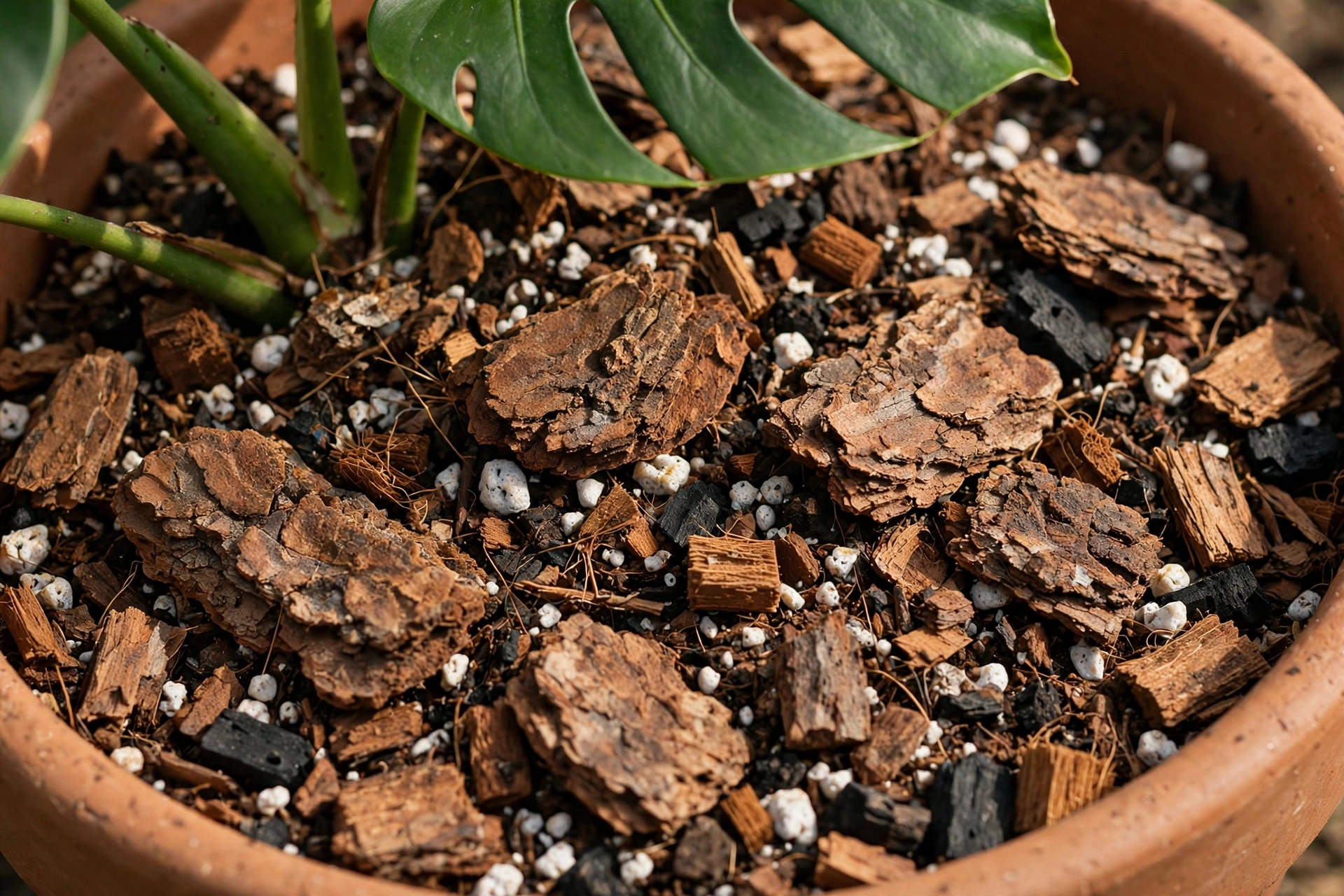
1. Chunky aroid mix — monstera, philodendron, pothos
These are climbing plants whose wild roots grip bark, so give them the chunkiest version: 3 parts soil (or coir) : 2 parts orchid bark : 1 part perlite. Big air pockets, fast drainage, something for aerial roots to grab. This is the exact blend our monstera care guide repots into, and it is the single easiest upgrade for a leggy, slow monstera.
2. Gritty mix — succulents, cactus, snake plants
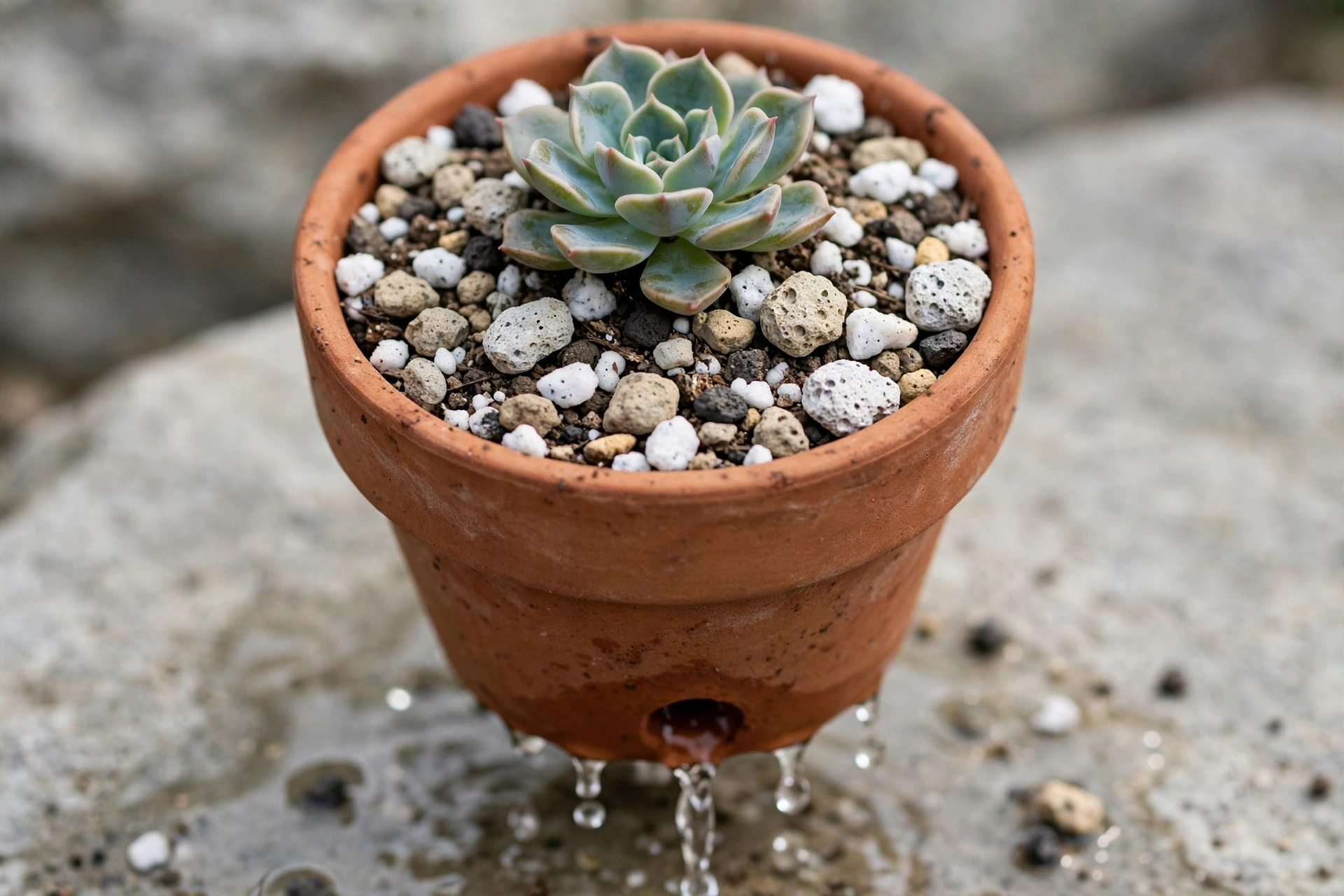
Desert plants want water to pass through like a sieve: 1 part potting soil : 1 part mineral grit (perlite, pumice, or coarse sand — combined, if you have them). The pot should drain almost as fast as you pour. Our snake plant care guide uses this blend, because a snake plant in dense wet soil is a plant on its way to rot.
3. Moisture-lover mix — ferns, calathea, peace lily
These plants want even moisture without stagnation: 3 parts soil or coir : 1 part fine bark : 1 part perlite, with the emphasis on never letting it fully dry. The structure is still there — “moisture-loving” never means “mud” — but the finer bark and higher soil share stretch the interval between waterings.
4. Budget mix — when you only have two ingredients
Bagged soil plus perlite alone, at 3 parts soil : 1 part perlite, is 80% of the improvement for 20% of the effort. If bark is unavailable or the budget says no, do this and skip nothing else. It is dramatically better than bagged soil straight.
Bend the mix to your home, not just the plant
The same plant can want different mixes in different houses. Three adjustments matter most:
- Pot material. Terracotta breathes and dries a mix fast — a moisture-lover in terracotta may want the finer mix. Plastic and glazed pots hold water — lean chunkier.
- Light. Low light means slow drinking; slow drinking means wet soil; wet soil means you should open the mix up. A plant in a dim corner gets the next-drainage-level-up version of its recipe.
- Your watering hand. Honest self-knowledge beats any recipe: heavy waterers should mix chunkier, forgetful waterers finer. The right mix is the one that forgives YOUR habits.
The two myths that drown plants
“Put rocks at the bottom for drainage.” The oldest advice in gardening, and it backfires: water does not move freely from fine mix into coarse gravel — it perches above the boundary, saturating the bottom layer of soil where the deepest roots sit. A uniform mix, top to bottom, in a pot with a drainage hole drains better than any gravel layer. (This is also why “pot with no hole” is the true villain: no mix recipe survives a sealed pot of standing water.)
“Garden soil is more natural.” Outdoor soil in a pot compacts to concrete, drains terribly in a container’s shallow column, and can import pests and pathogens into a closed indoor system. Potting mixes are soilless on purpose. Natural is a garden bed’s virtue, not a pot’s.
Mixing, storing, and refreshing
Mix on a tray or in a storage tub — a batch keeps indefinitely in a sealed bin. Handle dry perlite gently or wear a simple dust mask: its dust is an irritant you do not need to breathe, and wetting the mix as you work keeps it down. Refresh on a rhythm: even a good mix breaks down over 12–18 months as bark decomposes and fines accumulate, which is why repotting into fresh mix revives plants that “nothing was wrong with.” If the top of an older pot has gone dense and water pools before soaking in, that is the mix asking to be replaced, not the plant asking for more water.
Clemson University’s Home & Garden Information Center publishes indoor plant soil mixes of its own, including the classic Cornell recipes, if you want to compare formulas before you commit to a batch.
Soil mix questions, answered
Can I just use bagged potting soil on its own?
You can, and millions of plants survive it — the question is for how long, and with how much watering anxiety. Straight bag mix compacts within a year, holds water unevenly, and is the common thread behind the rot problems in our guides. Adding perlite and bark takes ten minutes and a few dollars per batch; it is the highest-value ten minutes in houseplant care.
Is coco coir better than peat as the base?
They are close cousins: coir re-wets more easily after drying out and is the more renewable resource; peat holds slightly more water and is often cheaper. Either makes a fine base once you add structure. The bark and perlite matter far more than which of the two you start from.
How much does mixing your own actually cost?
Less than the premium pre-mixed bags it outperforms. Bark and perlite are among the cheapest products in the garden center, a bag of each seasons many batches, and a mid-priced base soil completes it. Rough economics: your per-pot cost usually lands below the fancy ready-made aroid mixes, with fresher structure, because you mixed it this month rather than it sitting bagged for a year.
My soil grows white mold or fungus gnats. Will a chunky mix fix that?
It removes their favorite condition: a surface that stays wet and airless for days. A structured mix, allowed to dry at the top between waterings, makes both problems far less likely — and our fungus gnats and white mold guides cover the full clean-up if they are already established
Should I add fertilizer to the mix?
A handful of worm castings per gallon gives gentle, slow background feeding and is hard to overdose. Beyond that, feed in the watering can on the plant’s schedule rather than loading the mix — a built-in charge of strong fertilizer is how young roots get burned, and it washes out long before the plant has used it anyway.
