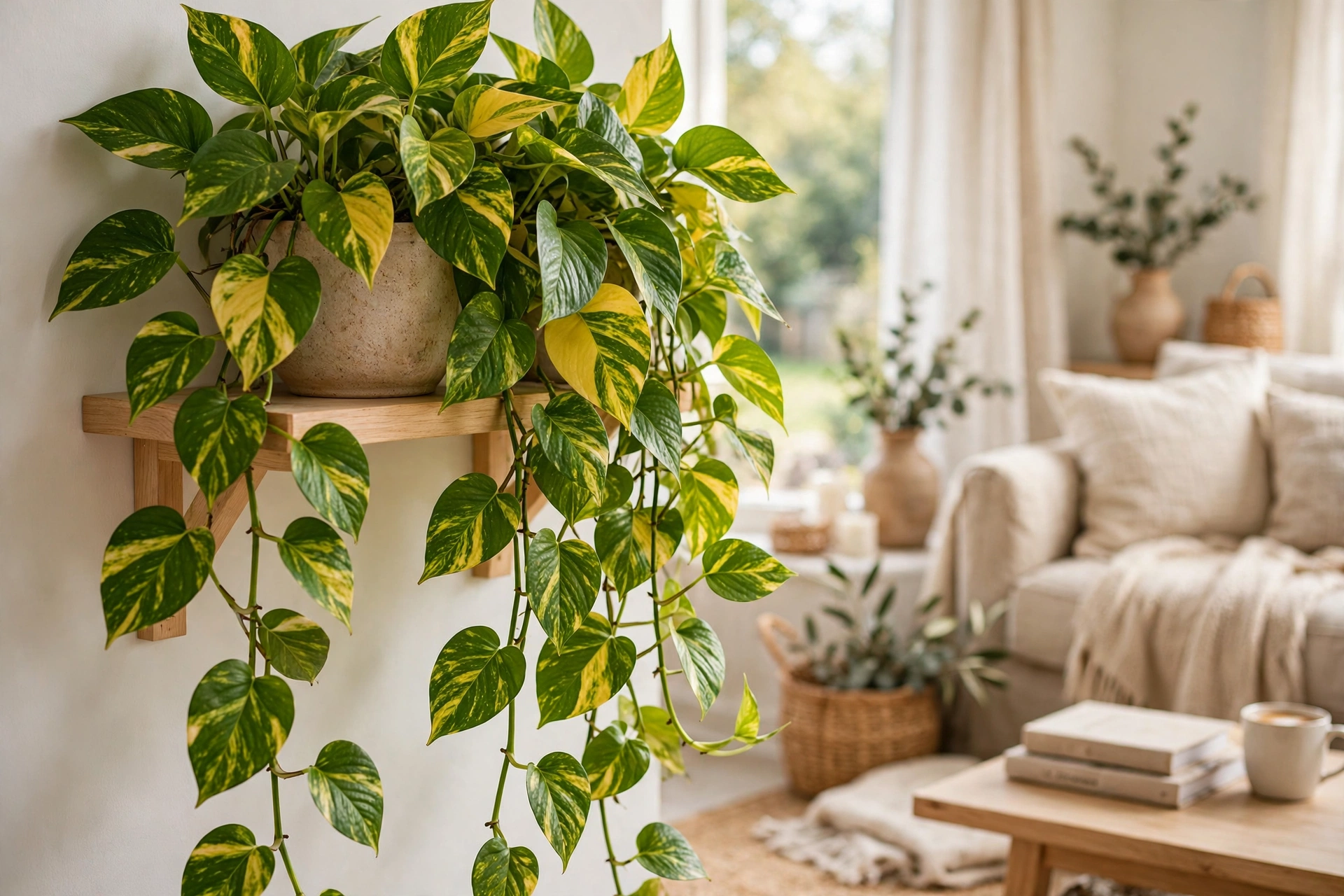
Pothos Care Guide: Light, Water, Soil & Fixes
You bought the plant everyone calls unkillable — and now its leaves are yellowing. So you water it more, because that’s what care looks like. Two weeks later it looks worse, and you’re standing there wondering how you managed to kill the one plant that was supposed to survive anything.
Here’s the truth nobody prints on the tag: pothos rarely die of neglect. They die of kindness — water given on a schedule instead of on need. Good pothos care isn’t a schedule — it’s a rhythm: light first, water second, food last. Follow it, and your pothos will do what pothos are famous for — trail, climb, and forgive.
Quick answer: Give pothos bright, indirect light; water only when the top 1–2 inches of soil are dry; plant it in a loose, well-draining mix in a pot with a drainage hole; feed lightly in spring and summer. It tolerates low light and the odd missed watering — what it can’t tolerate is sitting in wet soil.
Table of Contents
Quick Care Card — Pothos (Epipremnum aureum)
| Botanical name | Epipremnum aureum (family Araceae) — the tropical vine behind “golden pothos” and “devil’s ivy” |
| Light | Bright, indirect; tolerates medium and low light (slower growth) |
| Water | When the top 1–2 inches of soil are dry |
| Soil | Loose, well-draining mix with perlite or bark |
| Humidity | Average home humidity (30–50%) is fine; 40–60% ideal |
| Temperature | 65–85°F (18–29°C); keep above 55°F |
| Fertilizer | Balanced, half strength, monthly in spring and summer |
| Toxicity | Toxic to cats and dogs — see the pet-safety section below |
Light: the setting everything else depends on

Pothos comes from the forest floor and lower trunks of tropical forests, where light arrives filtered through leaves. Recreate that, and the plant does the rest.
Bright, indirect light is the sweet spot — a few feet from an east or south window, or behind a sheer curtain. In this light pothos grows fastest and holds its variegation: the cream and yellow marbling on golden and marble varieties is the first thing to fade when light drops.
Pothos tolerates low light — a hallway, a north-facing room, an office corner — and that tolerance is exactly why it’s famous. But tolerance isn’t preference. In low light the vines grow long and sparse, the leaves come in smaller and plainer green, and the soil dries so slowly that overwatering becomes easy. If your pothos looks stretched and dull, it is almost never a food problem. It’s a light problem. And one honest detail: leaves that have already reverted to plain green stay green. It’s the new growth that patterns again once the light improves.
One warning in the other direction: harsh midday sun through glass scorches leaves, leaving pale, papery patches. Bright is good; direct midday rays are not.
Field tip: Rotate the pot a quarter turn every week or so. Pothos grows toward the light, and that one small habit is the difference between a full plant and a one-sided one.
Water: read the soil, not the calendar
More houseplants die from watering schedules than from drought, and pothos is no exception. “Water every Sunday” ignores everything that decides how fast a pot dries: the light, the pot size, the soil, the season, the size of the root ball. So throw the schedule away and use the only instrument that matters — your finger.
The finger test: Push a finger into the mix up to your second knuckle. If the top 1–2 inches are dry, water. If it’s still damp, walk away. Then water properly: pour slowly until water runs from the drainage hole, let it drain for a few minutes, and empty the saucer. A pothos standing in a saucer of water is a pothos rotting in slow motion.
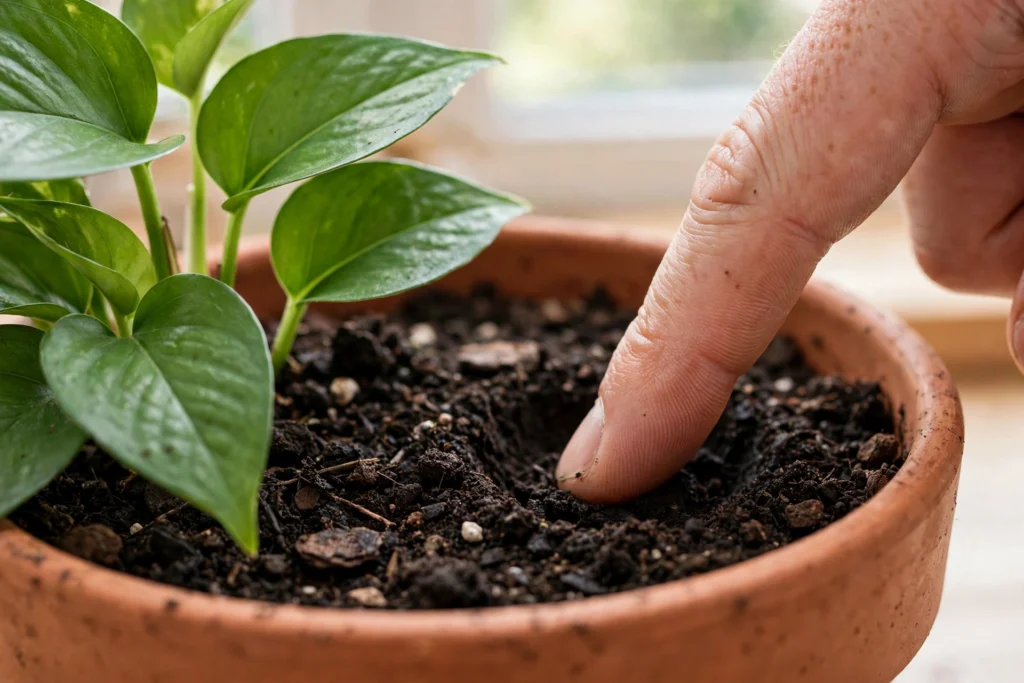
Two backup checks, for when you’re not sure. Lift the pot: a dry pot feels noticeably lighter than a freshly watered one, and after a few weeks your hand learns the difference. And watch the surface less than the root zone — the top can look dry while the roots below are still sitting wet.
In bright light and summer growth you might water weekly. In a dim corner in January it might be every three weeks. Both are correct — the soil decides.
Learn the plant’s own signal, too: a thirsty pothos droops softly, stems and all, and perks up within hours of watering. That droop is a useful backup warning — but don’t run the plant on it. A pothos that wilts hard between every watering is being stressed on repeat: leaves yellow at the base and growth stalls. The finger check, a few days before you’d expect the droop, is the routine. What you must never do is answer a droop caused by rotting roots with more water — which is why the problems table below starts with checking the soil, not reaching for the watering can.
One rescue worth knowing: if the mix has dried out so hard that water sheets straight down the sides of the pot without soaking in — it happens after vacations — set the whole pot in a basin of water for about half an hour and let it drink from below. Then drain it as usual.
Soil and potting: drainage is non-negotiable
In the wild, pothos roots grip bark and leaf litter — airy, chunky material that never stays soggy. Your mix should imitate that, not a garden bed.
A reliable recipe, in parts: 2 parts standard indoor potting mix, 1 part orchid bark, 1 part perlite. The bark makes the air pockets roots breathe through; the perlite stops the mix compacting back down over time. It should look visibly chunky, and water should run through it in seconds, not pool on top. If all you have is plain mix, a generous handful of perlite stirred through a pot’s worth does most of the job. Slightly acidic soil suits it (around pH 6.1–6.8), which ordinary potting mixes already are — no special products needed.
Two potting rules that matter more than any brand:
- The pot must have a drainage hole. No exceptions, and no “layer of gravel at the bottom” substitute — gravel doesn’t drain a pot. A hole does. Love the look of a sealed decorative pot? Keep the plant in its nursery pot inside it, and either lift it out to water or empty the decorative pot every time — a pothos sitting in its own runoff is the rot story again.
- Size up slowly. A small plant in a big pot sits in more wet soil than its roots can drink, and that is an open invitation to rot. When you do repot, go up just one size — about 1–2 inches wider. The next section walks through it.
Repotting, step by step
Pothos needs a new pot every 1–2 years, or sooner if the roots are circling the bottom, poking out of the drainage hole, or the plant droops again a day after watering because there’s more root than soil left. Spring, when growth is active, is the kindest time to do it.
- Water the plant a day before, so the root ball slides out without tearing.
- Choose a pot 1–2 inches wider than the current one, with a drainage hole. Terracotta is a smart pick in a dim spot — it wicks moisture and dries the mix a little faster.
- Tip the plant out gently, supporting the stems. Loosen the root ball with your fingers and shake off the tired old mix.
- Snip away any roots that are black and mushy — that’s rot, and it doesn’t go back in the pot. Healthy roots are pale and firm.
- Put a layer of fresh mix in the new pot, set the plant at the same depth it grew before, and fill around the sides, firming lightly.
- Water thoroughly until it drains, empty the saucer, and give it a week or two of bright, indirect light while it settles.
That’s the whole job. Most “repotting disasters” are really size disasters — a pot far too big, holding far too much wet soil.
Temperature and humidity: ordinary rooms are fine
Pothos is a tropical plant with modest demands. It’s happiest between 65–85°F (18–29°C) — ordinary room temperature — and should never sit below about 55°F. Keep it away from the two things that break that range: cold window glass in winter, and the direct blast of a heating or air-conditioning vent.
Humidity is where beginners overspend. Average household humidity (30–50%) is genuinely fine; 40–60% is ideal and encourages bigger leaves, but a humidifier is optional, not required. And never compensate for dry air by keeping the soil wetter — dry air is a leaf issue, wet soil is a root killer. If leaf edges crisp in a heated winter room, group plants together or set the pot on a pebble tray instead.
Fertilizer: a light feeder, in season only
Pothos is not a hungry plant. During active growth in spring and summer, feed once a month with a balanced liquid fertilizer at half the label strength. That’s all. Stop entirely in fall and winter, when growth slows and the plant can’t use the food.
And never feed a stressed plant: a yellowing, wilting, or freshly repotted pothos gets plain water until it’s growing again — fertilizer on damaged roots is salt on a wound.
More fertilizer does not mean more growth — it means salt building up in the soil, and salt burn is one of the classic causes of brown leaf tips. If you spot a white crust on the soil surface, or brown tips despite good watering, flush the pot: run plain water through it slowly several times to wash the salts out, and cut feeding back.
Pruning: how a trailing vine becomes a full plant
Left alone, pothos puts its energy into a few long vines. Pruning redirects that energy into fullness.
Cut with clean scissors just above a node — the bump where a leaf meets the stem — on any vine that’s getting long or leggy. The plant branches below the cut, and the cutting itself isn’t waste: it’s your propagation material for the next sections. One limit worth respecting: never take more than about a third of the plant’s leaves in a single session. It needs its green to fund the regrowth.
Pinching the soft growing tips of young plants does the same job before vines form. And pick off fully yellow or dead leaves at the base as they appear — the plant won’t repair them, and they only invite pests. One refinement: a leaf that’s only partly yellow is still feeding the plant, so let it finish before you remove it.
Trail it, or train it up a pole?
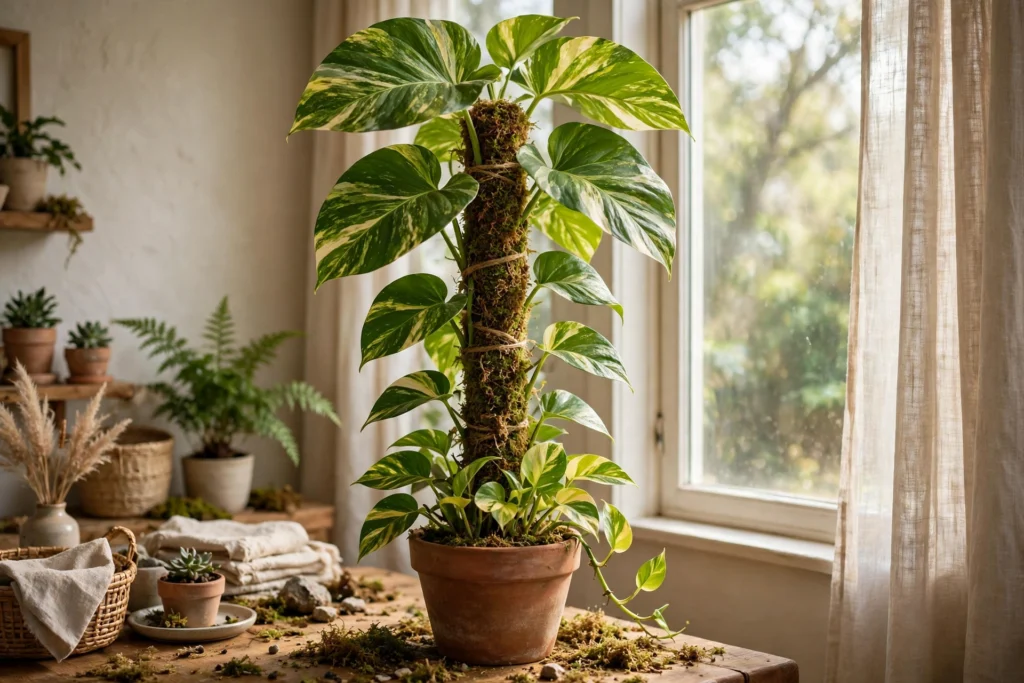
This is the choice most care guides skip, and it changes what your plant becomes. Left to trail from a shelf or hanging basket, a pothos stays graceful, and its leaves stay modest in size. Given something to climb — a moss pole, a coir pole, even a simple trellis — it does what it does on tree trunks in the wild: its aerial roots grip the support, the stems thicken, and new leaves come in noticeably larger.
Neither is wrong. Trail it if you like the waterfall look. Train it up if you want the big, lush, jungle leaves. Practical notes if you go the pole route: install the pole when you repot, sunk deep into the pot so it doesn’t wobble, and tie the vines up loosely with the aerial roots — the brown nubs along the stem — facing the pole. Keep the pole lightly moist so those roots will attach, and don’t soak it so hard that water constantly runs down into the pot — you’d be overwatering by the back door. And if a climbing plant still makes small leaves with long bare gaps, the problem isn’t the pole. It’s the light. Fix that first.
Propagation: new plants from one cutting

This is the easiest propagation in the houseplant world, and it starts with the node. A cutting roots only if it includes at least one node — that bump is where roots form.
In water:
- Cut a healthy stem 4–6 inches long, just below a node.
- Remove the leaves from the bottom half so none sit underwater.
- Stand it in a jar of room-temperature water, node submerged.
- Change the water weekly. Roots appear in 1–3 weeks in decent light.
- When roots are 2–3 inches long, pot it into mix and keep the soil lightly moist for the first week or two while it adjusts.
In soil: Push the node end into the mix directly, keep it evenly moist (not wet), and give it bright indirect light. Soil-rooted cuttings skip the water-to-soil adjustment, but they root a little less predictably.
| Water | Soil | |
|---|---|---|
| You can watch it happen | Yes — roots in the jar | No |
| Adjustment later | Needs a gentle move into soil | None — already home |
| Main risk | Forgetting water changes | Mix drying out early |
The fullness trick. Here’s the fix nurseries use for a pothos that’s lush at the ends and bald at the top: plant your rooted cuttings back into the mother plant’s pot, filling the bare crown. A shelf pothos that looks impossibly full is usually not one plant — it’s a crowd. Do it in spring, keep the soil a touch more moist than usual for the first month while the new roots settle, and the pot knits together into one full plant.
A pothos can also live in water permanently — just change the water weekly and add a drop of dilute fertilizer monthly, since water has no nutrients of its own.
Which pothos do you have? (A quick identification)
“Pothos” on a shop label is looser than you’d expect, and correct identification decides which advice applies.
True pothos is Epipremnum aureum. The varieties you’ll meet: Golden (green with yellow streaks), Marble Queen (heavy white marbling — wants the brightest light of the group to keep its color), Neon (chartreuse, nearly glowing), Manjula (broad, wavy, cream-splashed), N’Joy (small leaves, crisp green-and-white pattern), Pearls and Jade (white, green and grey marbling around the leaf edges), and Jade (plain, deep green, and about as unfussy as a plant gets). All share the care in this guide; the paler the variety, the more light it needs to hold its pattern. And if a variegated plant throws a fully green shoot, prune that shoot out — plain green growth is more vigorous and will quietly take over the plant if you let it.
“Satin pothos” or “silver pothos” is usually Scindapsus pictus — a close relative with matte, silver-flecked leaves. It looks similar and trails the same way, but it grows more slowly and wants a little more humidity and gentler watering. If your “pothos” has velvety leaves with silver spots, that’s your plant — this guide’s basics still serve it well, just water a touch more carefully.
Common problems: symptom → cause → fix
Work down the table in order. Almost every pothos problem is water, light, or food — in that order of likelihood.
| Symptom | Likely cause | Fix |
|---|---|---|
| Yellow leaves, soft stems | Overwatering / root rot | Check roots; trim black, mushy roots; repot into dry mix; water less |
| Drooping whole plant, dry soil | Thirst | Water thoroughly; it should recover within hours |
| Leggy vines, small plain leaves | Too little light | Move to bright indirect light; prune to encourage branching |
| Brown, crispy leaf tips | Fertilizer salt, low humidity, or inconsistent watering | Flush the soil; steady the rhythm; check humidity |
| Pale scorched patches | Direct sun through glass | Move back from the window or add a sheer curtain |
| Tiny white cottony clusters | Mealybugs | Dab with rubbing alcohol on a cotton swab; repeat weekly until gone |
| Fine webbing, speckled leaves | Spider mites | Wipe leaves with a damp cloth; treat with neem oil or insecticidal soap |
| Hard brown bumps on stems | Scale insects | Rub off with an alcohol-dipped cotton swab; prune badly hit stems |
| Tiny black flies around the pot | Fungus gnats — the mix stays too wet | Let the top of the mix dry fully between waterings; our fungus gnats guide has the full eviction |
The yellow-leaf row deserves emphasis, because it’s the one that starts this whole story: if the soil is wet and the leaves are yellow, do not water. That’s the mistake this guide opened with — and it’s the one fixable habit that saves more pothos than any product. (Our full guide to yellow pothos leaves walks through the diagnosis leaf by leaf.)
Pet safety: read this before you place the plant
Pothos is toxic to cats and dogs. The ASPCA lists Epipremnum aureum among plants toxic to both, because its leaves and stems contain insoluble calcium oxalate crystals. A pet that chews it typically experiences oral irritation and swelling of the mouth, tongue and lips, along with drooling, vomiting, and difficulty swallowing.
What to do with that fact:
- Place it out of reach — a high shelf or hanging planter turns a trailing plant into a safe one, which is easy precisely because pothos trails. Pick up fallen leaves, too, and keep that jar of rooting cuttings up high — it’s the one pothos most likely to get tasted.
- If your pet chews it: remove plant material from the mouth, rinse the mouth with water, and call your veterinarian or an animal poison line. Don’t wait for severe symptoms.
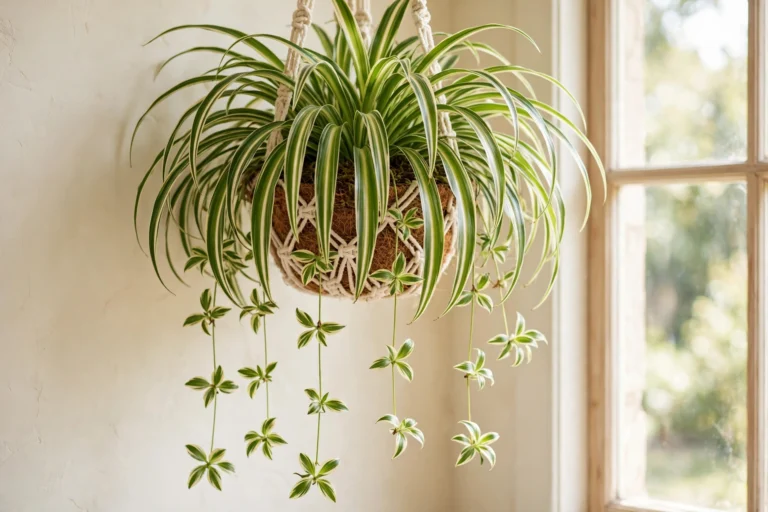
- Want the trailing look without the worry? Our pet-safe houseplants list checks the alternatives against the same ASPCA data — the spider plant in that list trails happily and is listed as non-toxic.
Frequently asked questions
How often should I water my pothos?
Whenever the top 1–2 inches of soil are dry — not on a fixed day. That might be weekly in summer and every few weeks in a dim winter room. The finger test never lies; the calendar often does.
Why is my pothos not growing?
Usually light. In low light pothos survives but barely grows. Move it to bright, indirect light, confirm you’re feeding lightly in spring and summer, and growth — up to 6–12 inches a month in the growing season, in good conditions — resumes.
Can pothos live in water forever?
Yes. Change the water weekly, add dilute fertilizer monthly, and trim any slimy roots. It won’t grow as fast as in soil, but it will live happily in a jar for years.
How long does a pothos live?
Typically five to ten years — and often much longer with steady care. Because cuttings root so easily, many owners keep the same plant going for decades, one generation of vines at a time.
Is pothos an air-purifying plant?
Pothos is often sold with that claim. It can absorb some airborne compounds in sealed lab chambers, but in a real home you’d need a jungle to measurably change air quality. Grow it because it’s beautiful and forgiving — that’s reason enough.
When should I repot my pothos?
When roots circle the drainage hole or growth stalls despite good care — usually every 1–2 years. Move up one pot size only, in spring if you can choose. The step-by-step above walks through it.
Why is pothos called devil’s ivy?
Because it’s famously hard to kill — it survives dim corners and missed waterings and stays green through all of it. The name is a compliment to its stubbornness, not a warning.
Is pothos the same plant as heartleaf philodendron?
No — they’re cousins so alike they’re constantly sold under each other’s names. Pothos leaves are thicker and waxier; heartleaf philodendron leaves are thinner and softer, with papery sheaths on the new growth. Happily, the care is nearly identical, so this guide serves either plant.
Why are there water droplets on my pothos leaf tips?
That’s guttation — after a good watering, the plant pushes a little excess water out through the leaf tips, usually overnight. It’s harmless and stops as the mix dries. Just wipe the drips off the furniture.
The weekly rhythm (your whole routine, on one card)
- Look: droop? yellowing? new growth? Thirty seconds, once a week.
- Feel: finger in the soil, second knuckle. Dry → water deeply and drain. Damp → leave it.
- Turn: a quarter turn toward the room.
- Tidy: snip dead leaves; wipe dust off the big leaves so they can use the light.
That’s it. The plant that “everyone kills” is almost never killed by doing too little — it’s killed by doing the wrong thing too often. Give it light, read its soil, and let it be the easiest relationship in your home.



2 Comments