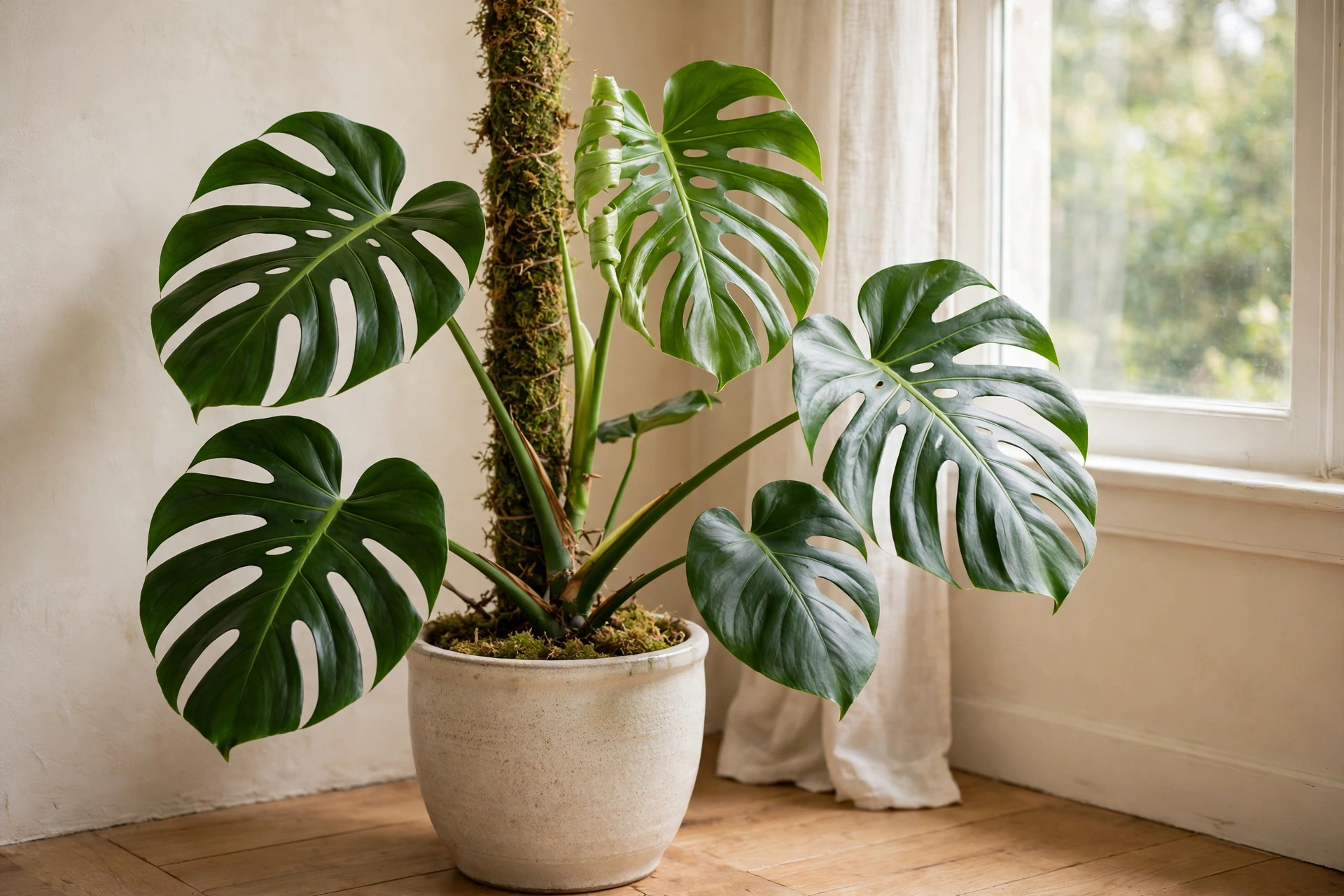
Monstera Care Guide: Light, Water, Soil & Fixes
You bought it for the leaves — the huge, glossy, split-and-holed leaves all over Instagram. But your monstera keeps pushing out plain green hearts, its stems sprawl sideways across the floor, and the whole plant looks less like a jungle statement and more like a vine that lost its way. So you water it more, feed it more, and wonder what is broken.
Nothing is broken. A monstera is a climber from the rainforests of Central America, built to haul itself up a tree trunk toward the light — and the famous splits only appear when it gets to live that way. Good monstera care comes down to the two things most owners skip: enough light, and something to climb. Give it those, plus the watering and soil basics in this guide, and the leaves you bought it for will follow.
Quick Answer
Give a monstera bright, indirect light, water when the top 2–3 inches of soil have dried, and plant it in a chunky, bark-heavy mix in a pot with drainage. Add a moss pole or sturdy support to climb — climbing is what triggers the big, split leaves. Keep it at 65–85°F, feed monthly in spring and summer, and keep it away from pets: it is toxic if chewed.
Table of Contents
Quick Care Card — Monstera (Monstera deliciosa)
| Botanical name | Monstera deliciosa (family Araceae — not a true philodendron) |
| Light | Bright, indirect light; more light means more splits and holes |
| Water | When the top 2–3 inches of soil are dry; soak and drain fully |
| Soil | Chunky aroid mix — potting soil with orchid bark and perlite |
| Temperature | 65–85°F; growth stalls below about 55°F |
| Humidity | Prefers 50–60%; tolerates average rooms, grows slower |
| Fertilizer | Balanced feed about monthly in spring and summer, none in winter |
| Pet safety | Toxic to cats and dogs (ASPCA) — see the pet safety section below |
Light: the split-leaf switch
Light is the whole personality of this plant. In the wild, a monstera starts life on the forest floor and climbs toward the canopy; the higher and brighter it gets, the larger and more fenestrated — split and holed — its leaves become. Your living room version follows the same script.
Set it a few feet from an east, south, or west window, where the light is bright but the sun does not sit on the leaves for hours. A little gentle morning sun is fine; harsh afternoon sun through glass scorches the leaves into pale, crispy patches. Clemson Extension makes the low-light consequence plain: monsteras grown in dim conditions will not form their characteristic perforations at all. A plant in a dark corner is not resting — it is producing small, plain, widely-spaced leaves and stretching its stems toward any light it can find, the growth habit growers call “leggy.”
If your brightest window is already taken, a simple grow light run 12–14 hours a day substitutes well — fenestration responds to total light, not to where the light comes from. Rotate the pot a quarter turn every week or two so all sides get their share and the plant grows evenly instead of leaning into a one-sided sprawl.

Field tip: Judge your monstera’s light by its newest leaf, not its oldest. New leaves arriving smaller, plainer, and further apart than the ones before them are the plant telling you the light is dropping.
Water: moist, never soggy
A monstera wants the rhythm of the rainforest floor: a thorough drenching, then a partial dry-down. Water when the top 2–3 inches of mix feel dry to your finger — in most homes that lands around once a week in summer and every two to three weeks in winter, but always let the soil, not the calendar, decide.
- Water slowly and deeply until it runs from the drainage holes.
- Wait ten minutes, then empty the saucer — roots sitting in water are how root rot starts.
- Let the top of the mix dry properly before the next round; the roots below stay lightly moist, and that is the balance this plant likes.
Leaves are your backup gauge. A monstera that droops slightly and perks up within hours of watering was simply thirsty. Leaves that curl inward can mean thirst too — or, if the soil is already wet, roots in trouble. Check the soil before you reach for the can, every time: the same droop can come from both too little water and too much, and the fix for one makes the other worse.
Soil and the pot: think forest floor, not garden bed
Monstera roots grow through leaf litter and bark on the rainforest floor, with air moving between the chunks. Bagged potting soil alone is too dense — it compacts, suffocates the roots, and stays wet long enough to rot them. Build a chunky aroid mix instead:
- The reliable recipe: 3 parts indoor potting soil, 2 parts orchid bark, 1 part perlite. It should look rough and lumpy, with water running through quickly.
- The shortcut: a bagged “aroid mix,” or potting soil with a generous handful of bark and perlite stirred in per pot.
The pot needs drainage holes, full stop. Go one size up at repotting — a much larger pot holds more wet mix than the roots can use, and wet mix is rot’s best friend. Because a climbing monstera gets top-heavy, a heavier ceramic or terracotta pot doubles as an anchor; lightweight plastic pots tip once the plant passes a few feet.
Give it something to climb

This is the section most care guides bury, and it is the one that changes the plant. A monstera’s aerial roots — the brown, finger-thick roots that emerge from its stems — exist to grip bark and pull the plant upward. When a monstera climbs, it matures: stems thicken, leaves enlarge, and the splits and holes appear. When it sprawls, it stays in juvenile mode, pushing out small solid leaves on long stems. NC State Extension notes these plants need sturdy support to keep the heavy stems from breaking.
- Install the pole early — at repotting, before the plant gets big. Push a moss pole or coir totem deep into the pot, close against the main stem, so it cannot wobble.
- Tie the stem, not the leaves. Loosely tie the main stem to the pole at a few points with soft plant ties, just below the nodes (the joints where leaves and aerial roots emerge).
- Aim the aerial roots. Tuck them toward the pole or down into the soil. Kept slightly moist, the pole gives them something to grip; in soil, they become ordinary feeding roots.
- Train new growth upward as it appears, adding ties every new node or two.
Field tip: Never cut off all the aerial roots because they look untidy — they are the plant’s climbing gear and part of its water uptake. If one is truly in the way, redirect it into the soil rather than removing it.
Temperature and humidity
Warmth is non-negotiable: 65–85°F is the comfort zone, growth slows sharply below about 55°F, and cold drafts from winter windows or air-conditioning vents will stall or damage leaves. Keep the plant out of the direct blast of heating and cooling vents, which also dries the air around it.
Humidity is where monsteras show their rainforest roots. They prefer 50–60%; average homes sit nearer 30–40%, and the plant will tolerate that — but new leaves unfurl more easily and grow larger with moisture in the air. A small humidifier nearby is the fix that actually works. Grouping plants together helps modestly. Misting the leaves, by contrast, raises humidity for minutes and leaves water sitting in the leaf joints; skip it and wipe the leaves with a damp cloth instead — big leaves collect dust, and clean leaves photosynthesize better.
Fertilizer: steady, not strong
A monstera in active growth is a hungry plant, but it prefers regular small meals to occasional feasts. Feed with a balanced liquid fertilizer (a 1-1-1 or 3-1-2 ratio) at half strength about once a month through spring and summer, applied to already-moist soil in place of a watering. Ease off in fall, and stop entirely in winter when growth rests — feeding a resting plant just salts the soil. If a white crust forms on the mix surface, flush the pot with plain water at the next watering to rinse the buildup away.
Repotting, step by step
A young monstera typically needs a bigger pot about every two years — sooner if roots circle the drainage hole, push the plant upward, or water runs straight through without soaking in. Spring is the best moment, and it is also the moment to install or extend its pole.
- Water a day or two before, so the root ball holds together.
- Tip the plant out, supporting the stems. Wear gloves — the sap can irritate skin.
- Tease away some old mix and check the roots: firm and white or tan is healthy; black and mushy gets cut away with a clean blade.
- Set the pole in the new pot first, then the plant at its previous depth, filling around with fresh chunky mix.
- Tie the stems to the pole, water thoroughly, and let it settle in bright indirect light for a week before feeding.
Propagation: it all comes down to the node
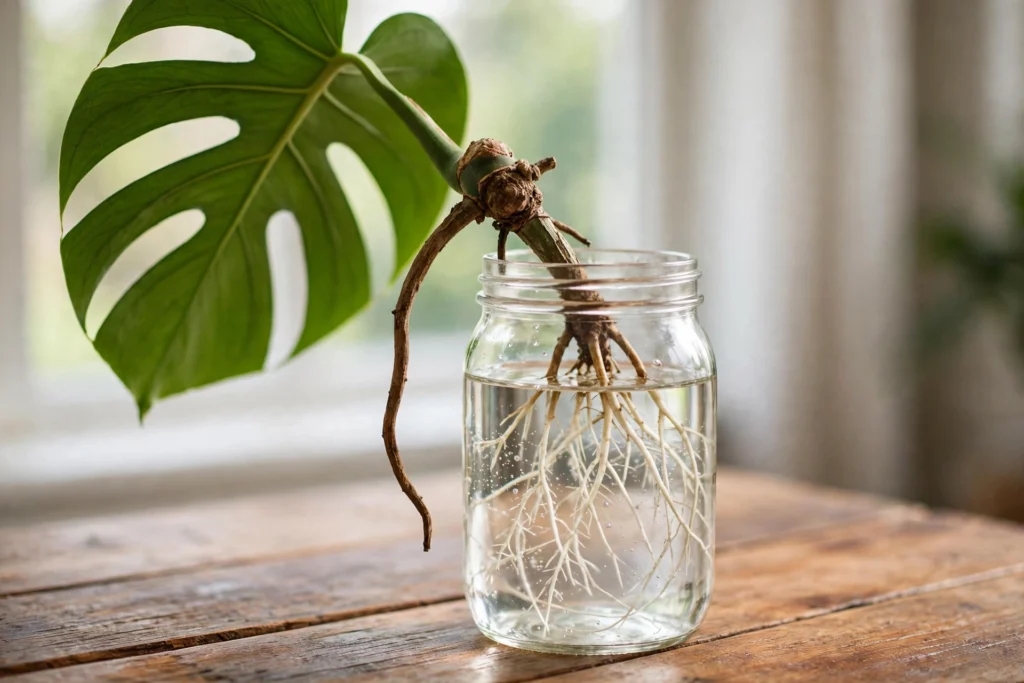
A monstera cutting succeeds or fails on one detail: the node. That knobbly joint on the stem — where a leaf stalk meets it, often with an aerial root starting — is the only place new roots and growth can come from. A leaf with a length of bare stem but no node will sit in water for months and never root. Get the node, and propagation is easy.
Stem cuttings (the standard method). Cut just below a node, taking a section with at least one or two leaves and, ideally, an aerial root. Stand it in a jar of water in bright indirect light, changing the water every few days. Roots typically appear within a few weeks to a couple of months. When they reach 2–3 inches — and have started branching — pot the cutting into chunky mix and keep it evenly moist for the first weeks while it adjusts to soil. Cuttings can also go straight into moist mix or sphagnum moss, skipping the water stage.
Air layering (the low-risk method). Wrap damp sphagnum moss around a node with an aerial root, still attached to the mother plant, and cover it with plastic wrap. Keep the moss moist. Once roots fill the wrap — a few months — cut the stem below the new roots and pot up a plant that never had to survive without them. It is slower, but almost nothing fails.
Common problems: what your monstera is telling you
| What you see | Likely cause | What to do |
|---|---|---|
| New leaves with no splits or holes | Not enough light, or the plant is still young | Move to brighter indirect light and give it a pole; see the note below |
| Yellow leaves | Thirst (oldest leaves, dry soil) — or rot (wet soil, soft stem) | Read the soil first: dry means water; wet and sour means unpot and check roots |
| Brown, crispy leaf tips and edges | Inconsistent watering, dry air, or fertilizer salts | Steadier watering rhythm; flush salts with plain water; raise humidity |
| Curling leaves | Thirst, or low humidity | Check soil moisture; if moist, raise humidity and move away from vents |
| Drooping leaves | Thirsty — or root rot if the soil is wet | Check the soil before watering; if soggy, inspect the roots |
| Black or dark brown spots on leaves | Fungal or bacterial leaf spot, fed by wet leaves and still air | Remove affected leaves, sterilize the blade after, improve air flow, keep water off the leaves |
| Long bare stems, small leaves, wide gaps | Legginess from low light | Brighter spot; prune the leggy stem below a node and propagate the cutting |
| White cottony blobs on stems and leaf joints | Mealybugs | Cotton swab with rubbing alcohol on each one; repeat weekly |
| Fine webbing, speckled leaves | Spider mites | Wipe every leaf top and underside; repeat weekly until clean |
The no-splits question deserves its own paragraph, because it is the complaint monstera owners search for most. Fenestration needs two things: maturity (leaves usually start splitting when the plant is about two to three years old) and energy, which indoors means light. A young plant in bright light with a pole is on schedule even if its first dozen leaves are solid. Our dedicated guide to monstera leaves not splitting works through the causes in order — age, light, climbing, and the one almost nobody expects.
Varieties and look-alikes

- Monstera deliciosa (the standard) — the big one: leaves that can pass 2 feet across on a mature, climbing plant. Everything in this guide is written for it.
- ‘Thai Constellation’ — deliciosa splashed and speckled with creamy white, like a night sky. The pattern is stable because it runs through the plant’s tissue, but it grows slower and wants your brightest light.
- ‘Albo Variegata’ — bold white sectors and patches. Stunning, slower, and the white parts cannot photosynthesize, so it needs bright light and costs far more.
- Monstera adansonii (Swiss cheese vine) — a different species, often sold beside deliciosa and confused with it. Smaller, narrower leaves pierced with oval holes rather than deep splits; a trailing or climbing vine habit. Care is similar, in a smaller pot.
- Monstera dubia (shingle plant) — a curiosity: juvenile leaves lie flat against whatever it climbs, like shingles, before transforming entirely as it matures.
One naming note: “split-leaf philodendron” is a nickname, not a relationship — NC State Extension calls it a misnomer. The monstera is its own genus; true philodendrons are cousins, not twins.
Pet safety: toxic to cats and dogs
The ASPCA lists Monstera deliciosa as toxic to cats and dogs. Like its pothos cousin, it carries insoluble calcium oxalate crystals in its leaves and stems. A pet that chews one gets an immediate, nasty reaction — intense burning and irritation of the mouth, tongue, and lips, excessive drooling, vomiting, and sometimes difficulty swallowing — which usually stops the chewing fast, but is miserable and warrants a call to your veterinarian or the ASPCA Animal Poison Control Center at (888) 426-4435 (a consultation fee may apply). The sap can also irritate skin, so wear gloves when you prune or propagate.
The plant’s size makes management easy: a monstera quickly becomes a floor plant too big to hide, so plan its spot in a room pets pass through but do not graze in, or behind a simple barrier while it is small. Our full monstera pet-safety guide goes deeper; and if you want the tropical look without the worry, our pet-safe houseplants list collects the ASPCA-cleared alternatives.
The monthly once-over
A monstera asks for care in bursts, not daily attention. Water by the soil check, feed monthly in season, and once in a while step back and really look at it: newest leaf bigger than the last? Stems still tied and climbing? Leaves wiped, lower ones checked for the cottony specks of mealybugs? That two-minute inspection, plus light it can actually use, is nearly all this plant ever wanted. Give it a tree’s worth of light and something to climb, and it will spend years repaying you in leaves the size of serving trays.
Monstera care questions, answered
Why are my monstera’s new leaves not splitting?
Usually light, then age. Splits and holes are the plant’s mature form: they need a plant roughly two to three years old, grown in bright indirect light, ideally climbing. A young plant, or any plant in a dim corner, keeps producing solid juvenile leaves — Clemson Extension notes low light prevents the perforations entirely. Move it brighter, give it a pole, and judge by the next few leaves.
How fast does a monstera grow, and how big will it get?
In good light, about 1–2 feet of growth a year, reaching full size in around three years. Indoors, expect a mature plant 6–8 feet tall with support; in its native habitat it climbs far higher. Growth nearly stops in winter and in low light — that pause is normal.
Is a monstera a philodendron?
No. It is nicknamed “split-leaf philodendron,” but botanists place it in its own genus, Monstera — NC State Extension flatly calls the nickname a misnomer. Both are members of the arum family (Araceae), which is where the resemblance ends.
Can I cut off the aerial roots?
You can trim one that is truly in the way without harming the plant, but do not remove them as a routine. Aerial roots anchor the plant to its support and absorb moisture; tucking them into the pole or down into the soil does more for the plant than cutting them. A cut root will not regrow from the same spot, though new ones form at other nodes.
How often should I water my monstera?
When the top 2–3 inches of soil have dried — roughly weekly in summer growth and every two to three weeks in winter in most homes. The finger test decides, not the calendar: light, pot size, and season move the interval more than any schedule can.
Does a monstera need high humidity?
It prefers 50–60% and grows its biggest, cleanest leaves there, but it tolerates the 30–40% of an average home without complaint — growth is simply a little slower and new leaves unfurl a little less gracefully. A humidifier helps more than misting, which barely moves the number.
Is monstera fruit edible?
In the wild, yes — deliciosa is named for it. The fruit is only safe fully ripe, when its scales fall away on their own; unripe fruit is loaded with the same oxalate crystals that make the leaves toxic. Indoor plants almost never flower or fruit, so treat this as trivia, not a harvest plan.
Why is my new monstera leaf small and pale?
New leaves always emerge a lighter green and darken over a week or two — that part is normal. A new leaf that stays small, though, is information: the plant is short on light, or its roots are cramped or hungry. Check the light first; it is the cause far more often than food.
What is the difference between Monstera deliciosa and Monstera adansonii?
Size and leaf shape. Deliciosa is the giant — broad leaves with deep splits along the edges and holes near the midrib. Adansonii is a smaller vining species whose narrower leaves carry rows of oval holes but rarely split at the edges. They are sold side by side as “Swiss cheese plants,” which is where the mix-up starts.



2 Comments