Why Are My Monstera Leaves Not Splitting?
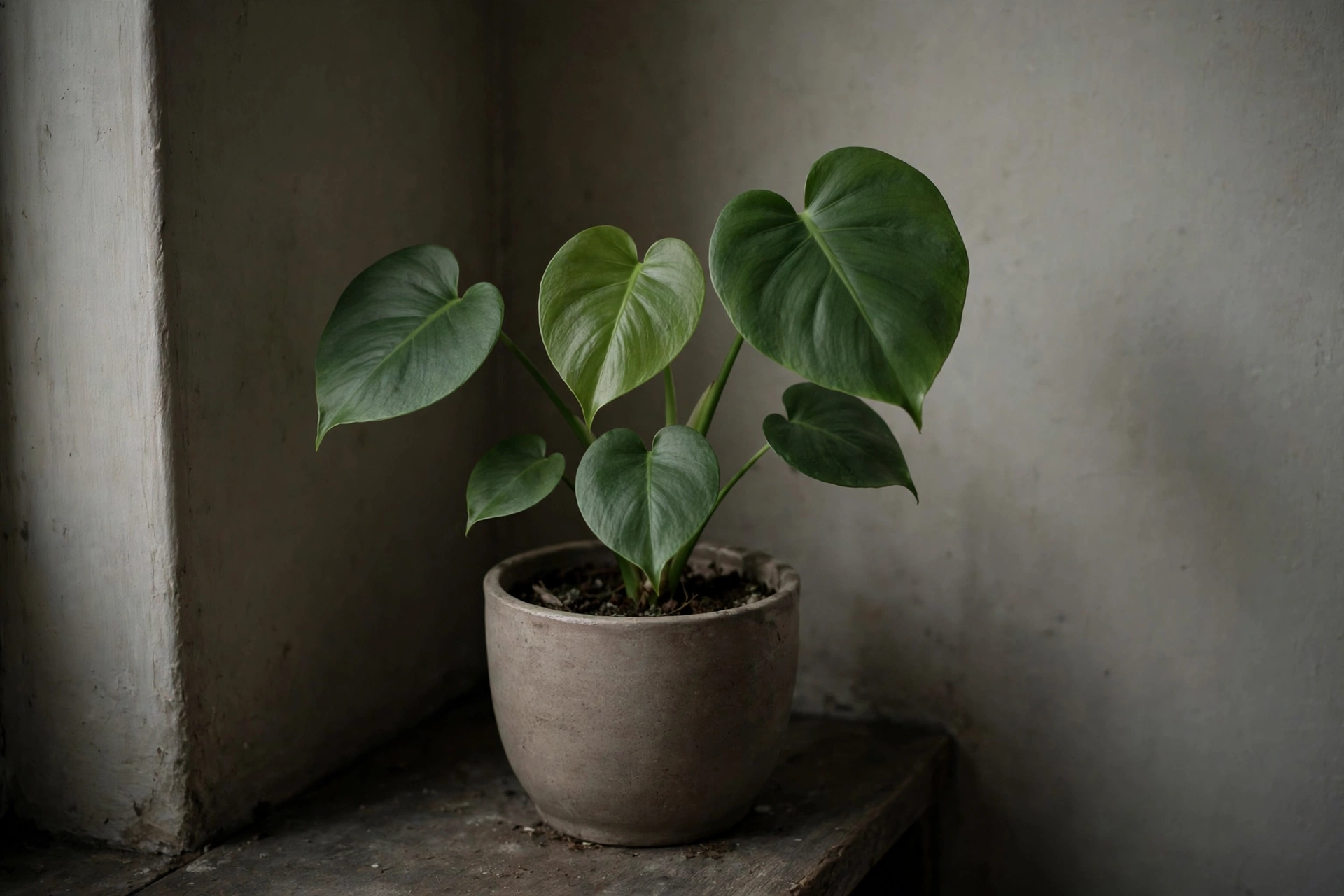
You checked the photos before you bought it. You cleared the corner, bought the big pot, maybe even the moss pole still standing unused beside it. And month after month, your monstera produces the same leaf it produced on day one: smooth, heart-shaped, entirely whole. No splits. No holes. Just green hearts on longer stems, while the plant in the shop window wears leaves like cut paper.
So the questions arrive in order: is it broken? Is it even a real monstera? Did I buy the wrong plant? Almost certainly not, not, and probably not. Monstera leaves not splitting is your plant telling you something specific about its age, its light, and its living arrangement — and one of the causes is a piece of biology almost nobody mentions: the leaves already on your plant will never split, no matter what you do. Read on; the fix is real, but it works on the leaves that have not grown yet.
Quick Answer
Monstera leaves not splitting almost never means a broken plant — it is young, under-lit, or sprawling instead of climbing, and usually all three. Fenestration (the splits and holes) is the plant’s mature form: it needs a plant roughly two to three years old, bright indirect light, and support to climb. Fix those, then judge by the next three to five new leaves. The solid leaves already open will stay solid forever — that is normal, and it is the fact that makes owners think nothing is working.
Table of Contents

The biology in one minute: two plants in one
A monstera lives two lives. The juvenile plant — the one in the nursery pot — produces solid, heart-shaped leaves and stays low, hunting for something to climb. The mature plant, hauled up a tree trunk into brighter light, produces the famous fenestrated leaves: deep splits from the edges and oval holes along the midrib. Botanists call the change a growth-phase shift; growers just call it growing up.
Two details of that biology explain nearly every “my monstera won’t split” case:
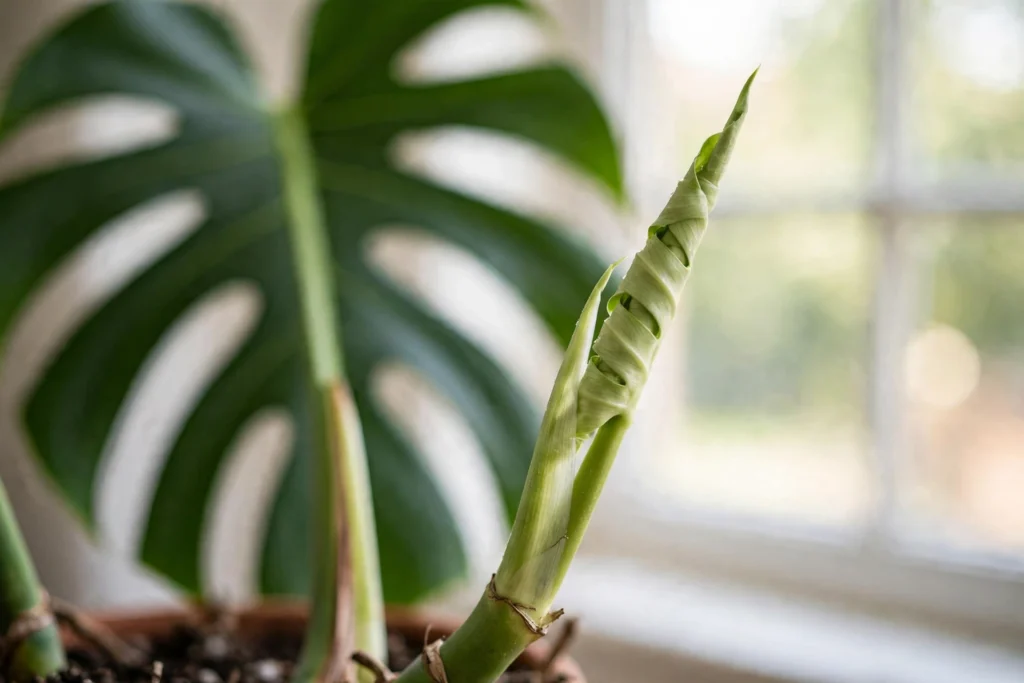
- The splits are decided before the leaf opens. Fenestrations form while the leaf is still furled in its sheath. A leaf that unfurls solid is finished — it will never develop splits later, however perfect conditions become. Progress can only ever show on new leaves.
- Each new leaf builds on the last. Maturity is gradual: leaves enlarge and fenestrate step by step up the stem. Expect the sequence — small solid, bigger solid, first notch, first holes — not a sudden transformation.
Which means the real question is never “why won’t these leaves split” but “what is stopping the plant from maturing.” There are five answers, in the order they usually apply.
Cause 1: It is simply young
The Spruce puts a number on it: a monstera’s leaves usually do not split until the plant is two to three years old. Nursery plants are sold young, small, and cute — often propagated that same year. A plant in its first year or two at home making solid leaves is not behind schedule; it is on it.
The tell: the plant is small, recently bought, and growing steadily — just without fenestration. Everything else (color, pace, new leaves) looks healthy.
The fix: time, plus the light and climbing below, which decide how soon “two to three years” arrives. A happy plant reaches maturity at the early end of the range; a struggling one can stay juvenile indefinitely — which is why age alone is rarely the whole story.
Cause 2: Not enough light — the energy shortage
Splitting is expensive. A fenestrated leaf is a big, engineered structure, and a plant builds it only when energy is abundant — and indoors, energy means light. Clemson Extension states the consequence directly: monsteras grown in low light will not form their characteristic perforations. The Spruce’s version is the same coin’s other side: the more light the plant receives, the more it will split; less light produces smaller, less showy leaves.
The tell: new leaves arriving smaller or no larger than the last, stems stretching with wide gaps between leaves, the whole plant leaning toward the window. If your monstera lives more than a few feet from a window with nothing supplementing it, this is almost certainly your cause — alone or stacked on Cause 1.
The fix: bright, indirect light, and more of it than feels intuitive. A few feet from an east, south, or west window; or a grow light 12–14 hours a day, which the plant reads exactly like window light. Move a dim-kept plant brighter gradually over a week to avoid scorching leaves that have adjusted to shade. This is the highest-leverage change on the list.
Cause 3: It is sprawling instead of climbing
In the wild, the phase shift to mature leaves is tied to the climb: the plant ascends, light increases, stems thicken — and the leaves transform. A monstera left to sprawl across a floor or trail off a shelf stays in the ground-hunting juvenile mode, producing solid leaves on long thin stems, because as far as the plant’s biology is concerned, it has not found its tree yet. NC State Extension notes the plant needs sturdy support regardless, just to hold its heavy stems.
The tell: long wandering stems, leaves facing every direction, no support in the pot — or a pole installed but the stems never actually tied to it.
The fix: a moss pole or coir totem, stems tied in below the nodes, aerial roots aimed at the pole — the full method is in the climbing section of our monstera care guide. Climbing does not replace light; the two together are the maturity signal. Pole without light still gives solid leaves; light without climbing gives a big sprawling plant that matures slowly and unevenly.

Cause 4: The plant keeps being restarted
Here is the cause almost nobody expects. A monstera matures along a stem, leaf by leaf — but a cutting starts the count over from juvenile. Plants propagated from small cuttings, plants repeatedly pruned back hard, and bargain plants that are really a bundle of young cuttings in one pot can all be “old” in years while every individual stem is young in the only way that matters. The pot’s birthday is not the stem’s.
The tell: many thin stems in one pot rather than one thickening main stem; a plant you have owned for years that has never once produced a larger leaf than the one before.
The fix: pick the strongest stem, give it the pole and the light, and let it climb uninterrupted. Resist chopping it for cuttings for a full season. Maturity is a streak — let the plant build one.
Cause 5: It is not a deliciosa at all

Sometimes the plant is innocent and the label is guilty. Several look-alikes are sold under the monstera name, and their adult leaves simply do not do what deliciosa’s do:
- Monstera adansonii — narrower leaves pierced with rows of oval holes, but they rarely develop deliciosa’s deep edge splits. If your plant’s leaves are small, thin, and holey-but-never-split, it may be this species, growing exactly as it should. (Our monstera care guide’s varieties section shows the difference.)
- Rhaphidophora tetrasperma (“mini monstera”) — not a monstera at all, despite the shop name. It does fenestrate, but into a smaller, more delicate leaf; owners waiting for giant deliciosa foliage wait forever.
- A young philodendron or pothos mislabeled — heart-shaped juveniles of several aroids look alike on a nursery bench. A true philodendron will never fenestrate.
The fix: none needed — but expectations reset. If it is adansonii or Rhaphidophora, enjoy the plant it is, and buy a deliciosa (from a plant already showing one split leaf, if you want proof) for the corner you cleared.
The fix plan: what to do this week, and how to judge it
- Move it to your brightest indirect spot (gradually, over 5–7 days) or set up a grow light on a 12–14 hour day.
- Install the pole and tie the main stem in, aerial roots aimed at the moss. Do both in the same week — light and climbing are one signal, delivered together.
- Feed the rhythm, not the hope: water when the top 2–3 inches dry, feed lightly once a month in spring and summer. Fertilizer supports growth; it cannot substitute for light, and no feeding schedule forces splits.
- Then wait — and count leaves, not days. In active growth, expect visible progression within the next three to five new leaves: bigger first, then the first notch or holes. In winter, growth pauses and so does the experiment; judge it in spring.
If five good leaves arrive in bright light on a climbing plant and every one is solid and no bigger than the last, go back to Cause 5 and re-examine the label. That outcome, with the big three fixed, is the one case where identity really is the likely answer.
What will not work
- Waiting for the current leaves to split. They cannot — fenestration is set before unfurling. Leaving a plant in the same dim spot “to see” only spends another season of juvenile leaves.
- Cutting off the solid leaves. They are the plant’s solar panels and food factory. Removing them starves the very growth you are waiting for. Prune only what is damaged.
- Feeding harder. Fertilizer is not light. Overfeeding salts the soil and burns roots (our problems coverage in the care guide), slowing maturity further.
Monstera splitting questions, answered
Will my monstera’s existing leaves ever split?
No — and this is the single most useful fact in this guide. A leaf’s splits and holes form while it is still furled; a leaf that opens solid stays solid for life. Every improvement you make shows up only on leaves that have not emerged yet. Owners abandon working fixes all the time because they watched the wrong leaves.
How long until my monstera gets split leaves?
If the plant is young but conditions are fixed — bright light, climbing, steady care — expect the first fenestrations as it passes roughly two to three years of age, appearing gradually over successive leaves. A plant bought already mature can fenestrate on its very next leaf once light and support are right. Count in leaves and seasons, not weeks.
Does a moss pole guarantee split leaves?
No. The pole is half the signal; light is the other half, and it is the senior partner. A climbing plant in a dim corner stays juvenile. A well-lit plant with a pole is the combination that matures — think of the pole as permission and the light as the budget.
Will a grow light work, or does it need a window?
A grow light works. Fenestration responds to the amount of light the plant receives, not its source — Clemson Extension’s point about low light applies to total light. Run a decent grow light 12–14 hours a day at the distance the manufacturer suggests for foliage plants, and a windowless corner becomes a viable monstera home.
My monstera had split leaves when I bought it, but the new ones are solid. Why?
The nursery gave it more light than your home currently does. The plant has slid back toward juvenile leaf production under lower energy — the reverse of the maturity sequence. Nothing is damaged; move it brighter (gradually), and the leaves will re-fenestrate as the energy returns, each new leaf a step back up.
Should I cut off the plain leaves to encourage split ones?
No. Solid leaves are feeding the plant and building the stem that will carry the split ones. Removing them delays exactly what you want. The only leaves worth removing are yellowed, damaged, or diseased ones.
Are monstera leaves with holes and monstera leaves with splits the same thing?
Two forms of the same feature — fenestration. Holes (windows) open along the midrib inside the leaf blade; splits cut in from the edges. A maturing deliciosa typically shows holes first, then deeper splits on later leaves. Both are signs of the same progression, and both are driven by the same three things: age, light, and climbing.


One Comment